Showing posts with label From the High School Lesson Book. Show all posts

Monday, January 20, 2025

From the High School Lesson Book: Inauguration Day


January 20, 2025 is the date for the United States presidential inauguration of Donald J. Trump as the 47th President. It also happens to be Martin Luther King Jr Day, which means many have the day off work or school. Although I've watched previous inaugurations on TV, I couldn't recall whether they took place on a third Monday of January, or a specific date in January, so I did the same thing I used to do as a homeschool mom . . . I did a few minutes worth of research, and wrote about it!

The date for the presidential inauguration was set as January 20th back in 1933. Prior to that, March 4th had been the date for this ceremony. A longer timeframe following election day was necessary so that the votes could be tabulated and reported and results ratified, since it involved a lot of travel. As you might imagine, technology advances allowed reporting and traveling to happen much more quickly, so less time was required. In addition, on a few occasions that lengthy lame-duck period caused significant problems. Notably, following the 1860 election, seven states left the Union earning that time period the nickname "Secession Winter". Abraham Lincoln was the President-elect but had not taken office, and had no authority to take action, and outgoing President James Buchanan declined to take any action, and left the issue for the new administration. During the Depression, President-elect Franklin D. Roosevelt had no authority to implement his promised New Deal, and the already troubled stock markets reflected the extra months of uncertainty. 

The 20th Amendment was ratified on January 23, 1933, and established January 20th as Inauguration Day, and January 3rd as the first meeting of the new Congress. So when FDR was re-elected, his 1937 inauguration took place on January 20th. 

Flickr - USCapitol - Franklin D. Roosevelt's First Inauguration

Did you know? The only part of the Inauguration Day ceremonies and festivities that is required by the Constitution is the recitation of the presidential oath of office. It's one of three oath or affirmation clauses in the Constitution, and it's the only one with specified wording. The Constitution does not specify who should administer this oath, but with only a few exceptions, this duty has been carried out by the Chief Justice of the Supreme Court. 

Before he enter on the Execution of his Office, he shall take the following Oath or Affirmation: ― "I do solemnly swear (or affirm) that I will faithfully execute the Office of President of the United States, and will to the best of my ability, preserve, protect and defend the Constitution of the United States." ~United States Constitution, Article II, Section One, Clause 8
The Vice President, who serves as President of the Senate, is sworn in during the same ceremony, immediately before the President takes the oath of office. This oath of office is the same one sworn by senators, representatives, and other government officials. 

Everything else is tradition! Including the location of this swearing-in ceremony. The news has been buzzing about the decision to move the 2025 Inauguration indoors due to the extremely cold weather, but there is no mandate to hold the event in front of the United States Capitol. The west front of the Capitol facing the National Mall, with the Washington Memorial and Lincoln Memorial providing a backdrop, has been a preferred location since the 1981 inauguration of Ronald Reagan. 

President Ronald Reagan Being Sworn In on Inaugural Day at the United States Capitol

From 1829 through 1977, most swearing-in ceremonies were held at the Capitol's east portico, on a platform over the steps. They've also been held inside the Old Senate Chamber, in the House of Representatives, and the Capitol Rotunda. The Rotunda will be the location for President Trump's inauguration in 2025, as it was for President Reagan's second term when the weather was also extremely cold. 

USCapitolRotunda

Other Inauguration Day traditions:

A joint procession to the Capitol by the outgoing and incoming presidents. While this has been a tradition most years since 1837 when Andrew Jackson and Martin Van Buren shared a carriage ride (Van Buren had been Jackson's VP), it comes as no surprise that at least a few of those shared rides seemed uncomfortable! A few presidents even skipped the ceremony altogether.

The honorary departure of the outgoing president. It used to be that outgoing presidents accompanied the incoming presidents back to the White House following the inauguration. In 1909 Theodore Roosevelt departed for his home immediately after the swearing in of his successor, and a new tradition was begun. Since 1977 the tradition was for the new President and First Lady to accompany their predecessors to the presidential helicopter and the short flight to Joint Base Andrews. 

The inaugural parade. Originally a ceremonial escort to the swearing-in, this shifted to a parade after the ceremony in 1841. 

The inaugural luncheon. The tradition of the outgoing president hosting the new president at a White House luncheon following the swearing in goes back to the 1800s. Since 1953, the new president has been the guest of honor at a Capitol luncheon hosted by senators and representatives. 

Inaugural Balls. When George Washington first took office, a gala event was held in his honor a week later. The first formal inauguration day ball was held for James Madison in 1809. 

A letter to the Presidential successor. This modern tradition began in 1989 when Ronald Reagan left a humorous encouraging note to George H.W. Bush. A letter of congratulations and encouragement has been left on White House stationery for the incoming president.


Don't miss a coffee break! Subscribe to HS Coffee Break by email 

 ©2006-2025 HS Coffee Break. All rights reserved. All text, photographs, artwork, and other content may not be reproduced or transmitted in any form without the written consent of the author. This post was written by a human. http://kympossibleblog.blogspot.com/ 

 This post may contain affiliate links - using affiliate links from HS Coffee Break helps fuel this blog. We are a participant in the Amazon Services LLC Associates Program, an affiliate advertising program designed to provide a means for us to earn fees by linking to Amazon.com and affiliated sites.

Monday, September 2, 2024

From the High School Lesson Book - Labor Day


In the United States and Canada, Labor Day (or Labour Day in Canada) is on the first Monday in September. It's been a national holiday since 1894 and was originally a day set aside to pay tribute to working men and women. Most other national holidays mark a significant historical event, usually associated with an armed conflict, but Labor Day isn't tied to any specific person or event, and has no religious background either.

All other holidays are in a more or less degree connected with conflicts and battles of man's prowess over man, of strife and discord for greed and power, of glories achieved by one nation over another. Labor Day is devoted to no man, living or dead, to no sect, race, or nation. ~Samuel Gompers

First United States Labor Day Parade, September 5, 1882 in New York City

The first Labor Day celebration was on Tuesday, September 5th, 1882. The Central Labor Union selected this day and planned a demonstration and picnic in New York City. In 1884 the first Monday of September was established as the date for an annual celebration, and the Central Labor Union urged other cities to set aside this 'workingman's holiday'. 

Labor Day parade on Pennsylvania Avenue, Washington, D.C. LCCN2017645684

Industry had been growing since the Industrial Revolution in the early 1800s and the working conditions were not always safe or wages fair. Labor unions formed to try and address these issues, and were becoming more vocal in doing so. They began organizing strikes, rallies, and protests, and unfortunately some of these turned violent.

Poorly paid labor is inefficient labor, the world over. ~Henry George

Capital is only the fruit of labor, and could never have existed if labor had not first existed. Labor is the superior of capital, and deserves much the higher consideration. ~Abraham Lincoln

In the spring of 1894, the American Railroad Union called for a boycott of Pullman cars, which crippled railway traffic. To break the strike, the government sent troops to Chicago, leading to riots, violence, and the deaths of a dozen railway workers. After this, in a move to quell further unrest, President Grover Cleveland suggested making Labor Day a national holiday and then signed the legislation making it so. 

Labor Day 3c 1956 issue U.S. stamp

Every day I remind myself that my inner and outer life are based on the labors of other men, living and dead, and that I must exert myself in order to give in the same measure as I have received and am still receiving. ~Albert Einstein

For most Americans, the Labor Day long weekend is considered the end of the summer season, and the beginning of a new school year and football season. Many will host or attend a cookout. Ironically, since it's a big retail sales date, a lot of retail workers may actually be spending more time at work this weekend rather than getting the day off! So maybe if you're shopping or dining out today, be extra kind to those workers!


Hard work should be rewarded by good food. ~Ken Follett

If all the cars in the United States were placed end to end, it would probably be Labor Day Weekend. ~Doug Larson

Incidentally, in Europe and Asia, Labour Day is at the beginning of May.

Choose a job you love, and you will never have to work a day in your life. ~Confucius

All labor that uplifts humanity has dignity and importance and should be undertaken with painstaking excellence. ~Martin Luther King, Jr.


Our work keeps the world going, in a sense. It keeps us going as a society and as people. We may be grumpy about having to go to our jobs when we don't feel like it, be tired and just wish we could be lazy, and feel weighed down by the responsibilities we have as part of our work. We can have lousy attitudes about going to a job and about all the work we have to do just to keep our homes and families functioning. And of course we need to take a break and rest regularly! In fact, God established a pattern of creative work and rest from the beginning, and commanded his people to observe that rhythm in order to keep work and rest in proper balance. 

You are to labor six days but you must rest on the seventh day; you must even rest during plowing and harvesting times.
~Exodus 34:21~


But God intended for us to do the work of looking after the world and participating in the creative work of managing and tending all of creation. And intended that we would find joy and blessing in doing it. So as much as we might grumble about work, most people find that they get bored and must find something productive to do even if they don't need to go out and get that paycheck. Maybe a day like Labor Day is a good opportunity for us to get our work back into balance!

How happy is everyone who fears the LORD,
who walks in his ways!
You will surely eat
what your hands have worked for.
You will be happy,
and it will go well for you.
~Psalm 128:1-2~

Here is what I have seen to be good: It is appropriate to eat, drink, and experience good in all the labor one does under the sun during the few days of his life God has given him, because that is his reward. Furthermore, everyone to whom God has given riches and wealth, he has also allowed him to enjoy them, take his reward, and rejoice in his labor. This is a gift of God, for he does not often consider the days of his life because God keeps him occupied with the joy of his heart.
~Ecclesiastes 5:18-20~

*************************
This post appears first on A Fresh Cup of Coffee as W.Q. - Labor Day


Sources for this post include: Office HolidaysHistory


Don't miss a coffee break! Subscribe to HS Coffee Break by email 

 ©2006-2024 HS Coffee Break. All rights reserved. All text, photographs, artwork, and other content may not be reproduced or transmitted in any form without the written consent of the author. http://kympossibleblog.blogspot.com/ 

This post contains affiliate links - using affiliate links from HS Coffee Break helps fuel this blog. 

 We are a participant in the Amazon Services LLC Associates Program, an affiliate advertising program designed to provide a means for us to earn fees by linking to Amazon.com and affiliated sites.

Thursday, January 18, 2024

High School Writing Tip Sheets - Citing Your Sources (Update)

This post contains affiliate links - using affiliate links from HS Coffee Break helps fuel this blog. 


For the past few years I have been teaching high school writing in our homeschool tutorial co-op. Having seen several groups of students through the courses, I've noticed some issues and questions coming up regularly. I hope these Tip Sheets will be helpful to my students, their parents, and perhaps to other students and parent/teachers as well.

**********

In essays and research papers at the high school level, students should be able to provided a correctly formatted Works Cited page and should be able to use in-text citations, parenthetical citations, and signal phrases in their writing. Most students have learned at least some of these skills by the time they reach high school, but it can still be confusing. Here's a quick refresher and some good sources for more detailed information.

Source Information

As you're researching and taking notes, make sure to keep a record of all the sources you use, and which info came from which source. Note taking is probably an entire tip sheet of its own, but the basic gist is that you need to know specifically where each fact, quote, or reference comes from in the source. A good practice is to keep a Source Page or Working Bibliography as you research. Write down (or type) all the bibliographic information you'll need - author, title, publisher info, and date. For web sources, keep the specific URL and record the date you accessed the information. You may want to consider printing the information as well, if practical.

Works Cited Page

The most commonly used style is Modern Language Association (MLA), and if you use Google Documents or a Word program, you will find templates that format reports and Works Cited pages in MLA style automatically. Foolproof, right?! Well, yes, but you still have to know what information to plug in, what order it appears in, and how to correctly alphabetize the list. Alphabetize by the first item that appears for each source, which is usually the author's last name. Format is hanging indent, which means the first line of each entry starts at the left margin, and the second line is indented. Do not center. Works cited should appear at the end of your essay or paper, and on a separate page. Here's what it looks like using a couple of sources I recommend:


*Note that these examples are done following the 8th edition of MLA style.

In-Text Citations

When you use MLA documentation, you will use in-text citations, meaning you incorporate the source information in the text of your paper. When you use a fact, idea, or quote from one your sources, you use a signal phrase to let the reader know you're about to share something borrowed from the source. At the end of the quote or statement, you include a parenthetical citation that will refer the reader to the complete source information on the works cited page. Examples of signal phrases include:

According to author and teacher Sharon Watson,  . . .

" . . . ," writes Shona McCombes, a contributor at Scribbr.

At the end of the quotation or cited fact, you include a parenthetical citation. This is where you put the page number where the information is found in the source. If you did not include the author's name in the signal phrase, the author's last name should appear in the parentheses as well. Take a look at these examples:

In the textbook The Power in Your Hands, teacher Sharon Watson reminds students to include the credentials of anyone quoted so that readers will know the information is trustworthy (237). 

Correct punctuation can be a challenge, and questions often arise about the placement of quotation marks and end marks. A parenthetical citation is part of the sentence but not the quotation. "In other words, it appears after end quotation marks but before the period" (Watson 241). Another important detail to note is that there is no comma between the author's name and the page number.

**********

Those are the basics! Using in-text citations is not difficult, but it takes a bit of practice to remember some of the rules. Check out the following online sources with lots of detailed information about citing specific types of sources. 


On the Writing with Sharon Watson website, there are a number of free writing prompts and tutorials, including this one for In-text Citations for High School. You should also refer to the updated versions of a couple of lessons from the textbook I mentioned above, as the 8th edition of MLA style came out after publication of the textbook and there are a couple of changes to the format of citations. There is now a 9th edition of MLA style, and in my very quick check for changes to citations and Works Cited pages I didn't see anything different, but don't take my word for it! Go to the 2020 article: New Tutorials to Document Sources for an explanation of updates to MLA style and a link to download the 2020 lessons. These updated lessons from the textbook are available at no charge. 


The textbook The Power In Your Hands from Writing with Sharon Watson is the one I've taught from in the co-op for several years, and I highly recommend it. You can find out more in one of my full reviews. The most recent is: 


That review article was adapted and updated from our previous full review here: The Power in Your Hands (A Schoolhouse Crew Review) and an update in the Blogging Through the Alphabet series here: The Power in Your Hands (Blogging Through the Alphabet).

The Power in Your Hands (Writing Non-Fiction in High School) from Writing with Sharon Watson - A Homeschool Coffee Break review for the Schoolhouse Review Crew on kympossibleblog.blogspot.com  The Power in Your Hands (Blogging Through the Alphabet) on Homeschool Coffee Break @ kympossibleblog.blogspot.com

A previous version of this article was published on Homeschool Coffee Break in October 2021.

 Don't miss a coffee break! Subscribe to HS Coffee Break by email 

 ©2006-2024 HS Coffee Break. All rights reserved. All text, photographs, artwork, and other content may not be reproduced or transmitted in any form without the written consent of the author. http://kympossibleblog.blogspot.com/ 

 We are a participant in the Amazon Services LLC Associates Program, an affiliate advertising program designed to provide a means for us to earn fees by linking to Amazon.com and affiliated sites.


Saturday, June 17, 2023

From the High School Lesson Book - Happy Father's Day!

This post contains affiliate links - using affiliate links from HS Coffee Break helps fuel this blog. 


Father's Day is hopefully a time when the culture says, "This is our moment to look at who our men and boys are." ~Michael Gurian

Tomorrow is Father's Day in the United States and Canada, and as we celebrate dads, here's a little history about this day.


Father's Day in the western world is relatively new, and wasn't established until well after Mother's Day. I was surprised to find that the first officially proclaimed Father's Day in the US was in the 1960s and it wasn't until the '70s that an annual day was signed into law. 

There are a couple of claims to the first Father's Day celebration, but it's generally agreed that the distinction goes to Fairmont, West Virginia. Grace Golden Clayton suggested it for a memorial service for 362 men that had been killed in a mining explosion in the nearby town of Monangha. The service was held at Williams Memorial Methodist Episcopalian Church South on July 5, 1908.

An alternative "first" claim is a celebration held in 1915, suggested by the president of the Lions' Club in Chicago, Harry Meek.

Another important pioneer of the day was Mrs. Sonora Smart Dodd. Inspired by a Mother's Day service, she wanted to honor the memory of her father, William Jackson Smart. He was a Civil War veteran who had raised six children on his own after his wife died in childbirth. She'd originally suggested June 5th for the service, that being the anniversary of her father's death. However, because organizers wanted more time to prepare, the service was actually held on June 19, 1910 in Spokane, Washington. Mrs. Dodd delivered gifts to handicapped fathers, boys from the YMCA wore roses in their lapels―red roses if their fathers were still living, and white roses if their fathers had passed away―and the ministers in the city preached sermons about fatherhood.

During the 1920s and 1930s, Mother's Day was already established and while there was some interest in a Father's Day as well, there was also a movement to get rid of both days in favor of having Parents Day. Fathers were generally not on board with having their own day anyway, seeing it as sentimental and rather unnecessary. During the Great Depression, however, retailers saw the opportunity to encourage gift purchases for fathers, and promoted gifts of neckties, hats, socks, pipes and tobacco, and even sporting equipment that men were less likely to purchase for themselves when money was tight. During the 1940s, Father's Day was used to honor the men who were serving in the Armed Forces overseas. 

President Calvin Coolidge had recommended Father's Day as a national holiday in 1924, but it wasn't until 1966 that it was proclaimed as an official national holiday by President Lyndon Johnson. In 1972 President Richard Nixon signed into law the permanent Father's Day as the third Sunday in June.

Nowadays, the Father's Day weekend is a time to celebrate what Dad likes to do and to focus on the important roles dads play in kids' lives. In the 1920s and 1930s, when fathers weren't generally in favor of having their own day, the family dynamics were different. At that time, men were primarily the providers for the family, working long days away from the home, and women were usually at home doing all the hands-on work of raising the children. In today's families, modern roles are more of a partnership with moms and dads sharing in the responsibilities of caring for children. 

My father didn't tell me how to live; he lived and let me watch him do it. ~Clarence Budington Kelland


I heard recently that a majority of people say that of their family members, dads are the hardest to buy gifts for. And probably fewer men need the traditional gift of a tie on Father's Day too! Restaurant gift cards, dinner out, a sporting event, and apparel from a favorite sports team are popular gifts. I was also interested to hear that books are popular gifts for dads as well. Overall, Americans spend about one billion dollars of Father's Day gifts annually. About half of all Father's Day cards are purchased by sons and daughters, and about 20 percent are purchased by women to give to their husbands. The rest of the cards purchased are for grandfathers, uncles, brothers, sons, and 'father figures'. 

The power of a dad in a child's life is unmatched. ~Justin Ricklefs


My father gave me the greatest gift anyone could give another person: He believed in me. ~Jim Valvano


What about Father's Day celebrations in other parts of the world? In Spain, Portugal, Italy, and many Latin American countries―which are predominantly Catholic―Father's Day is on March 19th. This is the Feast of St. Joseph who is the patron saint of fathers. In Germany, Father's Day is recognized on the same date as Ascension Day. In Scandinavian countries, the day had been celebrated in the 1930s, but in 1949 it was decided that Father's Day should be moved to the second Sunday in November. The idea was to have it halfway through the year from Mother's Day and also to boost the retail economy during a traditionally slow period. Denmark didn't publicize the change, though, so they continued honoring fathers in June. And in Australia, New Zealand, and Fiji, Father's Day is on the first Sunday in September.

The importance and value of a loving and godly dad or father figure really can't be overstated. To a certain extent, our concept of God is shaped by our concept of a father, and the Scriptures present God as our Heavenly Father. In the prayer model he gave the disciples, and in his parables and teachings, Jesus consistently showed that God was a loving Father who cared for and provided for his children, and who disciplined and corrected them in both justice and mercy. In today's world, with so many broken families and so much confusion and controversy surrounding the meaning of masculinity and the roles of men, perhaps it's more important than ever that we honor and respect the men that are doing their best to follow the example of God in leading their families. 

And you saw in the wilderness how the LORD your God carried you as a man carries his son all along the way you traveled until you reached this place. 
~Deuteronomy 1:31~


As a father has compassion on his children,
so the LORD has compassion on those who fear him.
~Psalm 103:13~


Give a sincere thank you to our fathers, grandfathers, uncles, brothers, and sons who give so much of themselves to love, guide, protect, and provide for their families. Pray for them and for families.

He will turn the hearts of the fathers to their children, and the hearts of children to their fathers.
~Malachi 4:6~


This post will be linked at the Sweet Tea & Friends Monthly Link-up Party hosted by Grace-Filled Moments

Sources for this article include: AlmanacHistory.comOfficeHolidays.com, Readers Digest

 Don't miss a coffee break! Subscribe to HS Coffee Break by email 

 ©2006-2023 HS Coffee Break. All rights reserved. All text, photographs, artwork, and other content may not be reproduced or transmitted in any form without the written consent of the author. http://kympossibleblog.blogspot.com/ 

 We are a participant in the Amazon Services LLC Associates Program, an affiliate advertising program designed to provide a means for us to earn fees by linking to Amazon.com and affiliated sites.


Sunday, May 14, 2023

From the High School Lesson Book - Happy Mother's Day

This post contains affiliate links - using affiliate links from HS Coffee Break helps fuel this blog. 


Motherhood is the greatest thing and the hardest thing. ~Ricki Lake

I'm one of the lucky moms that gets to be with my kids this weekend―the Maryland kids anyway―so it's a good day for me! We are in Maryland for the weekend to celebrate our daughter's graduation from Mount St. Mary's University, and we had our Mother's Day dinner out on Friday evening. We're heading home sometime after church on Sunday, but will probably get back too late to see my Ohio family. I sent a card and letter to my Mom that I hoped would arrive on time, but I'm not counting on it. Sometimes it takes three days for my mail to reach its destination in Canada and other times it will take three weeks. But either way I'll call.

For some, Mother's Day is not a good day for various reasons. If it brings to mind pain or sorrow for you, I pray that you will find healing and peace.

Mother's Day 2021

Mother's Day 2019


Some form of Mother's Day is celebrated around the world, in more than fifty countries. The second Sunday in May is the "big day" in the United States, Canada, Australia, and many European countries. United Kingdom and Ireland celebrate in March, and Mexico and El Salvador celebrate on May 10th (so their "big day" was yesterday). France and Sweden celebrate later in May. Argentina celebrates in October, and Russia in November. 

Setting aside a day to honor mothers goes way back in history and at least a couple of very early traditions are related to religious practice. The ancient Greeks had a festival to honor the goddess Rhea, whom they believed was the mother of the gods. Early Christians honored Mary, the mother of Jesus, on a specific day during the Lent season. And the earliest version of Mother's Day in the United Kingdom was actually a Sunday during Lent on which everyone was supposed to attend their mother church. 

If you have a mom, there is nowhere you are likely to go where a prayer has not already been. ~Robert Brault

There are three suggested narratives for how our modern Mother's Day came about. In 1872, Julia Ward Howe, the writer of Battle Hymn of the Republic, pushed for a day dedicated to peace that would honor mothers. Another origin story involves Mrs. Juliet Calhoun Blakeley, who stepped into the pulpit when her pastor son left abruptly and called upon other mothers to join her. This was on the second Sunday of May in 1877. Her two sons made a practice of returning to their hometown to honour her and encouraged others to set aside the second Sunday of May to honour their mothers.

I am sure that if the mothers of various nations could meet, there would be no more wars. ~E.M. Forster

The story most of us have heard is about Anna Jarvis who began the movement to a national Mother's Day in 1907. She wanted a day to honour all mothers, living and dead, and felt this would help in bringing the country back together during the ongoing healing process following the War Between the States. In a church service on the second Sunday of May, she handed out her mother's favorite flowers, white carnations. She and her supporters wrote letters to clergy, businessmen, and politicians, and the movement and practice spread to most of the states by 1911. President Woodrow Wilson proclaimed the second Sunday of May in 1914 a national holiday in honour of mothers. 

Since President Wilson's proclamation, Mother's Day has continuously grown in popularity and is now a huge occasion for giving gifts and cards, and it's been said that Anna Jarvis was angry at how quickly the day became commercialized. 

The National Restaurant Association says it's the most popular day of the year to dine out in the U.S. with about 62 percent of Americans going to a restaurant. (This is why my family chooses a different day other than Sunday to go out!) 

The age of your children is a key factor in how quickly you are served in a restaurant. ~Erma Bombeck


It's the third largest card-sending holiday, with an estimated 150 million cards exchanged each year, according to the Greeting Card Association. And about 65 percent of card sales happen in the week leading up to Mother's Day!

Mother's Day is the busiest phone day of the year, with over 120 million calls placed. (Remember when the volume of calls slowed everything down and your call might not go through because everyone else was also phoning home? I sure do.)

There are more internet searches for 'flowers' leading up to Mother's Day than leading up to Valentine's Day. (Personally, I suspect this is because more people need to send flowers, while Valentine's flowers are more often given in person.)  One Mother's Day tradition is wearing a carnation. A colored carnation if your mother is still living, and a white carnation if she has passed away.

Mother's Day is the third largest retail holiday, according to the National Retail Federation. This year it's estimated that American consumers will spend over 21 billion dollars overall on Mother's Day. Wow!!

Everyone wants to save the world, but no one wants to help mom do the dishes. ~P.J. O'Rourke

When I was growing up, our church often opened up a time for anyone attending to say a few words about their mother. Of course there were many very heart-felt and moving statements of love and gratitude for moms, but there were always at least a few people who seemed overly sentimental and I had the impression it was a rehearsed speech so a box could be checked off. Annual obligatory statement about mother? Check. I always thought, and still do, that while it's absolutely wonderful to shower mothers with gifts and special treatment on this one day, but if that's the only day you call your mom or treat her right, you're doing it wrong. If you love your mom, you shouldn't need a Hallmark holiday or a big restaurant promotion to remind you to express your devotion.

Mothers are not the nameless, faceless stereotypes who appear once a year on a greeting card with their virtues set to prose, but women who have been dealt a hand for life and play each card one at a time the best way they know how. ~Erma Bombeck


While all old people have been young, no young people have been old, and this troubling fact engenders the frustration of all parents and elders, which is that while you can describe your experience, you cannot confer it. ~Andrew Solomon

When I am an old woman I shall wear purple. With a red hat which doesn't go, and doesn't suit me. ~Jenny Joseph

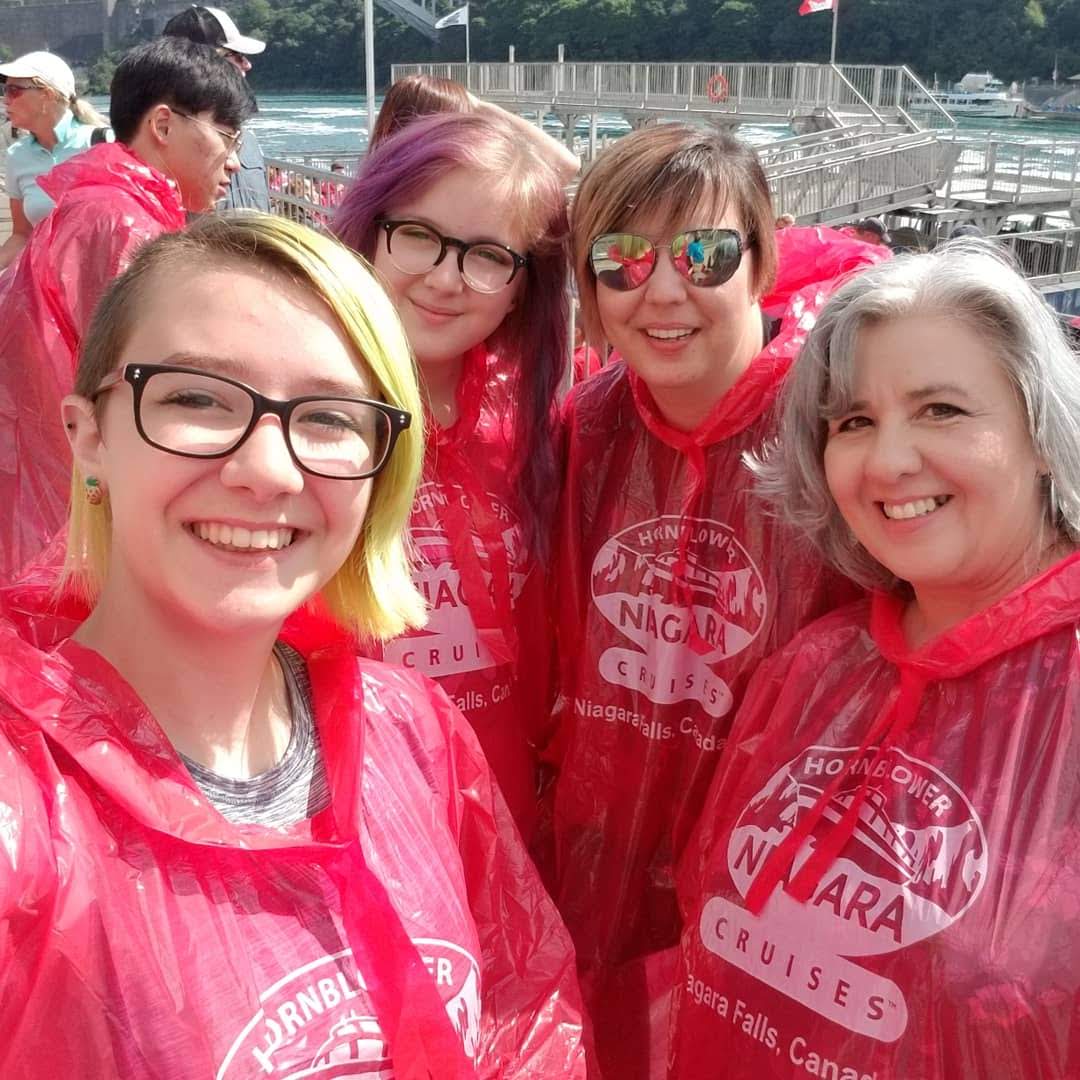
No purple hats but we're wearing red! My sister
and me with our daughters.

The experience of motherhood sure changes as you get older, doesn't it? I guess that's a question for moms who have been at it for quite a few years. The things that were once a big deal might not be so any more, and sometimes things that seemed trivial earlier take on new meaning. With a first baby, many of us are meticulous about recording every milestone, no matter how tiny. But there are plenty of jokes about how third, fourth, or fifth children don't even have a baby book to record their early years. I was kind of like that, starting a baby book with high hopes for each of my children, but just finding it hard to write everything down. But like most moms I know, I have lots of memories of my babies. Sometimes I just need something to jog that memory out of the mental filing cabinet. I do wish I'd written more down, of course. But I think it's safe to say that moms can keep memories in their hearts, where they mean the most, even if the dates and specific details get lost over the years. 

Youth fades; love droops; the leaves of friendship fall; a mother's secret hope outlives them all. ~Oliver Wendell Holmes

Children are the anchors that hold a mother to life. ~Sophocles

I think that's what Mary was doing. Storing away all the precious memories of her experience of her very unusual pregnancy, Jesus' birth story and his childhood, and all the prophecies and teachings that she had to ponder and fit everything together.

Then he [Jesus, at about twelve years old] went down to Nazareth with them and was obedient to them. But his mother treasured all these things in her heart.
~Luke 2:51~

And though her son was God himself, she and Joseph were obedient in raising him right and in the faith. What an example of a good mother! Timothy's mother and grandmother were heroes of faith as well, and examples to me.

I am reminded of your sincere faith, a faith that dwelt first in your grandmother Lois and your mother Eunice and now, I am sure, dwells in you as well.
~II Timothy 1:5~


Wishing a very happy Mother's Day to all the homeschool moms out there! 

Sooner or later we all start quoting our mothers. ~Anonymous

This post is adapted from WQ - Happy Mother's Day!, which appeared on A Fresh Cup of Coffee in May 2023.


 Don't miss a coffee break! Subscribe to HS Coffee Break by email 

 ©2006-2023 HS Coffee Break. All rights reserved. All text, photographs, artwork, and other content may not be reproduced or transmitted in any form without the written consent of the author. http://kympossibleblog.blogspot.com/ 

 We are a participant in the Amazon Services LLC Associates Program, an affiliate advertising program designed to provide a means for us to earn fees by linking to Amazon.com and affiliated sites.


Friday, May 5, 2023

From the High School Lesson Book: Coronation of King Charles III

This post contains affiliate links - using affiliate links from HS Coffee Break helps fuel this blog.


Are you planning to watch the coronation? I remember getting up at three in the morning to watch royal weddings on TV. I'm not getting up that early for this, but I do plan to watch some of it. It looks like the live coverage begins at 5 a.m. Eastern. The procession will begin at about that time, with King Charles and Camilla travelling from Buckingham Palace to Westminster Abbey in the Diamond Jubilee State Coach. The coronation ceremony begins at 11 a.m. (which is 6 a.m. Eastern). After the ceremony they will process back to Buckingham Palace, where the royal family will gather on the balcony for a military fly-past of over sixty aircraft. 
 
Curious about the music you'll hear at the Coronation? ClassicFM has been sharing lots of information on their website and Instagram. Here are some highlights:
  • What music will feature at His Majesty the King's coronation at Westminster Abbey? There will be a new coronation anthem by Andrew Lloyd Webber, and eleven other pieces by British composers commissioned by King Charles. There will be three soloists singing, and the service will be sung by the Choir of Westminster Abbey and the Choir of His Majesty's Chapel Royal, St. James's Palace. Also participating will be choristers from the Chapel Choir of Methodist College, Belfast and from Truro Cathedral Choir; singers from The Monteverdi Choir; The Ascension Choir; and the King's Scholars from Westminster School. You'll also hear music from the Royal Harpist, a Byzantine Chant Ensemble performing Greek Orthodox music, trumpet fanfares, and the great abbey organ.

Find out more about St. Edward's Crown, courtesy of the BBC. Find out more about all the Crown Jewels at Historic Royal Palaces.
  • Did you know? St. Edward's Crown is only worn at coronations, and is otherwise kept in the Tower of London. The last time it was worn was at the Coronation of Queen Elizabeth II in 1953.
  • Did you know? The crown is 360 years old, is made of solid 22-carat gold, and weighs nearly five pounds.
  • Did you know? The crown is set with 444 gemstones, including sapphires, rubies, amethysts, and topaz. There are four crosses and fleur-de-lis on the band, two arches that meet in the center, and the arches are set with gold beads. The band is trimmed with ermine.
  • Did you know? St. Edward's Crown was made for the coronation of Charles II in 1661 and named for an earlier king, Edward the Confessor, from the 11th century.


Saint Edward's Crown

St Edward's Crown by Francis Sandford
  • Did you know? The collection referred to as the Crown Jewels includes St. Edward's Crown, over one hundred objects, and thousands of gemstones. The entire collection is held in trust by the monarch for the nation, and has been housed at the Tower of London since the 1660s.
  • Did you know? The Coronation Regalia includes St. Edward's Crown, the Sovereign's Scepter with Cross, the Sovereign's Orb, and the Coronation Spoon. The Sovereign's Scepter with Cross holds the 3106-carat Cullinan Diamond. The Sovereign's Orb is meant to represent to the monarch that their power is derived from God. Are you curious about the spoon? It's used during the coronation to anoint the monarch with holy oil.

 Sovereign's Sceptre with Cross


CNN has published A visual guide to King Charles III's coronation, which has a lot of information and photos, and is worth checking out.

Go to the Royal Collection Trust website for Highlights of the Royal Mews, and learn about the horses, coaches, and carriages that you'll see in the processions. Beautiful!


See my related article From the High School Lesson Book: Victoria Day to find out more about the relationship between Canada and the United Kingdom, and why Canada has a long weekend in May to recognize a British monarch.

Dronning victoria

 Don't miss a coffee break! Subscribe to HS Coffee Break by email 

 ©2006-2023 HS Coffee Break. All rights reserved. All text, photographs, artwork, and other content may not be reproduced or transmitted in any form without the written consent of the author. http://kympossibleblog.blogspot.com/ 

 We are a participant in the Amazon Services LLC Associates Program, an affiliate advertising program designed to provide a means for us to earn fees by linking to Amazon.com and affiliated sites.


Tuesday, April 25, 2023

High School Writing Tip Sheets - Scenes, Summaries, and Stories

This post contains affiliate links - using affiliate links from HS Coffee Break helps fuel this blog. 


For the past few years I have been teaching high school writing in our homeschool tutorial co-op. Having seen several groups of students through the courses, I've noticed some issues and questions coming up regularly. I hope these Tip Sheets will be helpful to my students, their parents, and perhaps to other students and parent/teachers as well.

**********

Since I was back at my old stomping grounds this week, I had the opportunity to guest teach (it wasn't really substituting, since it was originally my class?!) at the co-op, and we talked about the difference between a scene and a narrative summary, and some related ideas when it comes to writing fiction. I thought that might be a good topic to discuss in a tip sheet too. 

Since my classes use the textbook Writing Fiction [In High School] from Writing with Sharon Watson, and follow most of the assignments in the given order, students are most often asked to write scenes. On occasion, they're assigned a short story but that's the exception. We learn about plot structures and aspects like the Major Dramatic Question that are related to an entire story, whether a short story of a couple of pages or a full-length novel, but the students are asked to write scenes. A fair question might be, "Why just scenes?" or even, "Why wait until this late in the text to explain the difference between scenes and stories?"

Writing just a scene instead of needing to write an entire story means that students can work with a smaller cast of characters, can jump into a story without developing all the background and how it all started, and can end their writing assignment on a cliffhanger, or without needing to resolve the conflicts they've created. So that answers the first why question.

The second why question is a little tougher, and after the first year I taught this course, I figured out that it was helpful right near the start of the year to explain what I expected when I assigned a scene, and what made a scene different from a whole story or narrative summary. A lot of my assignment reminders endeitd with a line something like, "Remember: you don't have to resolve all the conflicts. This is only a scene, so it's just part of a larger story that you don't have to tell in this assignment." 

The chapter that I taught from this past week, and will finish in the next class goes into the nitty gritty about the differences, discussing what constitutes a scene and what constitutes a narrative summary, and when and where a writer would need to use narrative summary.

What Is A Scene?

A scene could be defined as the action of the story being described in real time, and complete with the appropriate descriptions of action, dialog, and narrative actions. Generally, there will be enough information in a scene that it could be reconstructed and acted out without too much guesswork. If there's dialog between characters, much of it will be written out with speaker tags and narrative actions. The action of the scene will be sort of a blow-by-blow account of what the character or characters do. 

A scene is a story within a story, in a sense, because there should be a scene goal which is a lot like the Major Dramatic Question of the whole story. The protagonist, or the main character in the scene, has a goal, and some kind of obstacle arises to keep him or her from reaching that goal. By the end of the scene it's clear whether or not the character has achieved the scene goal, and there has been some conflict or tension introduced. There may be some new information introduced as well. 

A scene also takes place in one setting. A particular timeframe in the story, and in one general location in the story. It can be helpful to think of it as a scene in a stage play. The action of Scene I takes place inside the palace, for example, so that is the backdrop or set. At the end of Scene I there may be a curtain or the lights will go down so that the backdrop can be changed for Scene II, which takes place the next day in the garden. If time has passed but the location is the same, there may be a curtain in order to indicate to the audience that Scene III, which still in the garden, takes place a week later.

Beginning and Ending a Scene

The beginning of the scene needs to have setting established, so an indicator of place, time of day, weather, season, or whatever  is needed to let the reader know when and where this part of the story happens. The scene question should be stated or implied fairly early in the scene, and this can be done through dialog or description of the character's thoughts or feelings. Some conflict or obstacle will get in the way of the main character's attempt to get what he was hoping for in the scene. This may or may not be successful, but it should bring some tension into the story. 

By the end of the scene, this new conflict has been dealt with in some way, at least partially, and the character has either achieved the goal or hasn't. He may have also learned new information, or the reader may be given new information that impacts the story. The character's situation should have changed during the scene. He has learned something, lost something, gained something, been wounded, found a new ally or enemy, or won or lost a battle. The end of the scene should naturally lead to the next scene or hint at more conflict or complications to come. After all, unless this is the end of the novel, you want the reader to turn the page and keep reading!

What Is Narrative Summary?

It's called narrative summary because that's what it does. It summarizes and condenses the narrative, and it's a very useful tool when used correctly. Instead of that play-by-play dialog and action, the narrative summary will tell you in a sentence or two that the characters talked or did something, but without details. Think about a murder mystery novel. There might be a week that goes by between scenes during which the detective is working on the case but there are no significant developments. The narrative summary might be a paragraph stating just that. Or the narrative summary might be a paragraph or two that narrate the detective's thought process as he reviews all the information he has so far and figures out which lead to pursue next and how. Passages in a story that focus on what a character is thinking or their emotional state.

Narrative summary can also be used to describe setting, a character, or some detail; or to explain information that the reader will need to understand something in the story.

Narrative summary is often useful at the end of a scene, if the character needs to reflect on or process what has just happened in the scene's action. This is called a sequel. 

Quick Tips:

If your assignment is to write a scene, establish the time frame and place for your scene. You've already learned that your characters need motivation in the form of a Major Dramatic Question, so apply this same idea by giving your main character a scene goal. The overall goal for Rapunzel in the movie Tangled was to see the floating lights, but one scene goal would be to convince Flynn to be her guide. In another scene, her goal would be to heal the cut on Flynn's hand. Decide on the scene goal for your character and what conflict will get in the way of them achieving the goal. Write your scene, making sure you stay in that location and time frame. 

If you look back at what you've written and realize that it covers weeks or months or years, you've probably written narrative summary instead of a scene. If you intended to write a scene about an argument between a grown brother and sister, but most of what you've written is backstory about their childhood and why they haven't spoken to each other since they were teenagers, you've probably written narrative summary. 

If you're writing a short story, look for the same balance. The story will have more than one scene, and will need some narrative summary to connect those scenes. Generally, you want more scene than summary. That's where your proofreading and editing step can be very helpful. Have a critical eye to what is necessary to your story. Make the dialog worthwhile; use your description tools for those elements that are important for characterization and setting; make sure your narrative summary transitions are brief; and if necessary, use narrative summaries for a main character to reflect and plan between scenes.

When you write a story, you are telling yourself the story. When you rewrite, your main job is taking out all the things that are NOT the story . . . Your stuff starts out being just for you . . . but then it goes out. Once you know what the story is and get it right, as right as you can . . . it belongs to anyone who wants to read it, or criticise it. ~Stephen King

**********


Sources for this article include: Writing Fiction [In High School] from Writing with Sharon Watson

 Don't miss a coffee break! Subscribe to HS Coffee Break by email 

 ©2006-2022 HS Coffee Break. All rights reserved. All text, photographs, artwork, and other content may not be reproduced or transmitted in any form without the written consent of the author. http://kympossibleblog.blogspot.com/ 

 We are a participant in the Amazon Services LLC Associates Program, an affiliate advertising program designed to provide a means for us to earn fees by linking to Amazon.com and affiliated sites.