The story of the Bible is the story of peace―peace with God and with one another.
But peace isn't simply a feeling of calm or ease. It is a way of experiencing life as we were always meant to―in relationship with our Creator and with each other. We can recover a completeness that was once lost but is restored in the gospel.
The Peace of God Bible invites you to experience peace with God as you trace this important theme throughout Scripture. By meditating on it daily as you read 365 devotions and application notes, you will find the encouragement you need to live out of the wholeness you have in Christ―and be equipped to share that peace with others.
Jeremiah Johnston, PhD (General Editor) Bio: Jeremiah J. Johnston, PhD, is an elected member of the preeminent New Testament scholarly guild Studiorum Novi Testamenti Societas (SNTS) and minsters internationally as president of Christian Thinkers Society (www.christianthinkers.com). Jeremiah loves the local church, and also serves as pastor of apologetics and cultural engagement at Prestonwood Baptist Church.
Peace of God Bible features include:
Book introductions to help reveal the part peace plays in each book of the Bible
365 devotionals based on a key verse or passage to guide you in how to receive and live by God's peace
365 peace notes offering short, powerful insights to help you understand more deeply the wholeness you have in Christ
Topical indexes to help you study on your own how God's peace can shape different relationships in your life
Articles explore what the peace of God is, how to find or recover it, and how to experience eternal salvation because of what God has done for you
Concise concordance and index of features
End-of-page translators' notes and cross-references
Line-matched, double-column typesetting
Clear and readable 9.5-point NKJV Comfort Print®
My thoughts: Many times I've heard that peace is a theme throughout the Bible, and I know it's true, but seeing the devotionals and Peace Notes on almost every page in the Peace of God Bible really emphasized that truth. Not just in the verses that are very clearly about peace (Psalm 4:8 comes to mind), but in familiar passages that may not explicitly mention peace, such as Psalm 23, and in many passages that we might not associate with teachings about God's peace at all.
This devotional with Psalm 23 highlights just how knowing God as our "Good Shepherd" and understanding that he cares and provides for us leads to our experiencing peace.
The short Peace Notes throughout provide brief reminders on what the Bible says about peace and how applying God's truth will bring us into the peace he has for us. Peace characterizes the "sound heart" spoken of in the Proverbs. This note in the book of Habakkuk sees how the prophet's declaration could be viewed as his own plan for focusing on God's promises and peace, in a way I wouldn't have thought of.
I liked the topical index in the back, because it's a quick reference for seeking Scripture and related devotionals when one is needing to overcome worry and anxiety about specific topics.
As part of this promotion, Momentum is generously allowing me to host this giveaway of one copy of the Peace of God Bible. Please note: This giveaway is open to US only, opens on November 2nd and closes on November 9th. Fill out the entry form here, on my Giveaway Page on A Fresh Cup of Coffee.
This post may contain affiliate links - using affiliate links from HS Coffee Break helps fuel this blog. We are a participant in the Amazon Services LLC Associates Program, an affiliate advertising program designed to provide a means for us to earn fees by linking to Amazon.com and affiliated sites.
Rosh Hashanah, sometimes called the Jewish New Year, is being celebrated this week. In 2025, Rosh Hashanah begins the evening of Monday, September 22nd and goes through Wednesday, September 24th. Even though my family is not Jewish, as Christians we see the truth of the Messiah in all the Jewish feasts.
According to the Torah, the New Year actually begins with Passover, but Rosh Hashanah also signifies an opportunity to reflect and then to start anew. This day is also known as The Day of Trumpets or The Feast of Trumpets, and is the start of a ten-day period of repentance in preparation for the Day of Atonement (Yom Kippur). In Leviticus 23, God tells Israel: "On the first day of the seventh month you are to have a day of sabbath rest, a sacred assembly commemorated with trumpet blasts."
The blowing of the shofar (ram's horn) summoned the people of Israel to gather, whether for a sacred assembly, to break camp and move, to prepare for war, or to listen to the word of the Lord. The sound of the shofar commands attention and reminds us of the solemn necessity of turning back to God during these holy days.
This assembly known as The Day of Trumpets was a special sabbath with offerings and preparation that would turn the people back to God. It is a day linked to atonement, with God's instructions in Numbers 29 specifying, "a male goat as a sin offering to make atonement for you." There were other kinds of offerings by fire made as well; offerings not made today because there is no Temple or Tabernacle.
The Torah reading is about the patriarch Abraham's journey and willingness to obey God and offer his son Isaac as a sacrifice. But God provided a ram for the sacrifice instead! And we know that God has also provided a sacrifice for all of us - his own Son, Jesus the Messiah. God always provides.
It's traditional to eat fruits, honey cake, and apples dipped in honey. These sweet foods are a reminder of the biblical celebration described during the time of Ezra, when the people were instructed to "Go, eat rich food, drink sweet drinks, and send portions to those who can't provide for themselves; for today is consecrated to our Lord." (Nehemiah 8:10) Round or braided Challah is another traditional treat for Rosh Hashanah, and one I particularly love.
Add 3/4 tbsp yeast, 3/4 tbsp salt, 2 lightly beaten eggs, 1/4 cup honey, and 1/4 cup melted unsalted butter to 7 ounces lukewarm water in a large mixing bowl. Mix together, then stir in 3-1/2 cups unbleached flour with a wooden spoon. Don't knead, just mix with the spoon, although you might need to use your hands a bit. Lightly cover the bowl and let the dough rest for about two hours at room temperature. The dough should rise and then collapse or flatten a bit on top during that time. Then put it in the fridge for about an hour to make it easier to work with (or you can keep it up to five days covered in the fridge if you don't want to bake it right away).
Dust the dough with flour and cut off about half of it (size of a grapefruit or so) to make one loaf. Stretch and turn the piece of dough quickly into a ball and put it on a cutting board dusted with flour. Divide it into thirds using a knife. Roll each third into a ball and then into a rope. Braid the three ropes together, starting from the middle and going to one end, then turning the braid and braid from the middle to the other end. Let the braid rise on a cookie sheet that has been lightly greased or covered with parchment paper for an hour and twenty minutes. Twenty minutes before baking time, preheat the oven to 350*F and brush the loaf with an egg wash and sprinkle with sesame seeds.
Bake for about 25 minutes, or until golden brown. Let the challah cool before slicing and eating.
*********************
There is a custom called Tashlich (which means 'casting off') that is symbolic of seeking and offering forgiveness. Take a bag of breadcrumbs to a pond or lake and take turns with your family members tossing crumbs into the water and watching them float away. Micah 7:19 says that God "will cast all our sins into the depths of the sea." This is also a good time to reflect on whether we have wronged anyone and need to ask their forgiveness.
It's customary for Jewish people to greet each other with the wish "may your name be inscribed for a good year", or a simple wish for a sweet year:
L'Shana Tova!
"Blessed art Thou, O Lord our God, King of the Universe, who has kept us and sustained us and brought us to this season."
~Traditional Jewish blessing for Rosh Hashanah~
Just as the trumpet summoned Israel from ancient times, we look forward to the day when the trumpet will sound indicating the Messiah's return to gather all his people.
For the Lord himself will come down from heaven with a rousing cry, with a call from one of the ruling angels, and with God's shofar; those who died united with the Messiah will be the first to rise; then we who are left still alive will be caught up with them in the clouds to meet the Lord in the air; and thus we will always be with the Lord. ~I Thessalonians 4:16-17
This post may contain affiliate links - using affiliate links from HS Coffee Break helps fuel this blog. We are a participant in the Amazon Services LLC Associates Program, an affiliate advertising program designed to provide a means for us to earn fees by linking to Amazon.com and affiliated sites.
This post contains affiliate links - using affiliate links from HS Coffee Break helps fuel this blog.
Today is Pentecost on the Christian calendar, and in my experience, it seems that non-litrugical churches don't put much emphasis on this day. In fact, many evangelical believers don't even know what it is! Some of the churches I've belonged to have marked Pentecost and others have not made much of it, so it took me awhile to figure it out. Now, I believe it's quite important, for two reasons. First, it's one of the festivals that God commanded his people Israel to celebrate, which means it was a foreshadowing of how the law would be fulfilled when Messiah came. And second, that fulfillment on the Day of Pentecost recorded in the books of Acts was effectively the birth of the Church.
Pentecost is a celebration of God . . . a celebration of God's power . . . a celebration of God's desire to empower us and to dwell within us. ~Mark Hart
From the day of Pentecost until the present time, it has been necessary to be of one accord in prayer before the Spirit of God will work with mighty converting power. ~John Mott
My brethren, do you believe in the Holy Ghost? . . . Have we such a reliance upon the Holy Ghost? Do we believe that, at this moment, He can clothe us with power, even as He did the apostles at Pentecost? Do we believe that, under our preaching, by His energy a thousand might be born in a day? ~Charles Spurgeon
So what IS Pentecost? In the Old Testament, when God gave the law to Moses at Sinai, he instructed Israel to celebrate certain festivals every year. One of those was Shavu'ot, or the Feast/Festival of Weeks. This was a harvest celebration that took place 50 days after Passover. The 50 days is where the Greek name Pentecost comes from.
Then celebrate the Festival of Weeks to the LORD your God by giving a freewill offering in proportion to the blessings the LORD your God has given you. And rejoice before the LORD your God at the place he will choose as a dwelling for his Name―you, your sons and daughters, your male and female servants, the Levites in your towns, and the foreigners, the fatherless and the widows living among you.
~Deuteronomy 16:10-11~
This was a huge party to celebrate how God had provided and would continue to provide, and everyone in Israel was invited! All of Israel was expected to be there, and everyone who worshiped the God of Israel was supposed to be welcome!
So on the first Festival of Weeks after Jesus' death and resurrection, Jewish people from all over had come to Jerusalem to celebrate. Jesus had returned to heaven, but he had told his disciples to wait in Jerusalem for the Holy Spirit to come to them. They must have been ready to celebrate the Festival of Weeks as the law required, and I wonder whether they expected something very special to happen on the Day of Pentecost? They were all together and in prayer, and it was special indeed!
When the day of Pentecost came, they were all together in one place. Suddenly a sound like the blowing of a violent wind came from heaven and filled the whole house where they were sitting. They saw what seemed to be tongues of fire that separated and came to rest on each of them. All of them were filled with the Holy Spirit and began to speak in other tongues as the Spirit enabled them.
In Acts 2:5, Luke says that Jews "from every nation under heaven" were gathering in Jerusalem at the time for the Pentecost feast . . . It is one of three main festivals that brought hundreds of thousands of pilgrims to Jerusalem for a big celebration.
The "whole world" had come to them.
Pentecost sparked an international effort to include everyone, Jewish and non-Jewish, into God's family, which is one reason we see the "speaking in tongues" miracle happening. In Greek, "tongues" can refer to real human languages, and that seems to be Luke's point in Acts 2:8. He captures the question everyone is asking: "How is it that we each hear them in our own language to which we were born?"
So what is Pentecost Sunday all about? It's about this unexpected (yet expected) moment in 1st-century Jerusalem when the apostles' heads caught fire, when a strange indoor windstorm swirled through a packed party filled with international travenelers. It is the day foreshadowed by every wind-and-fire episode in the Old Testament and the day Jesus promised would happen as he quoted the prophet Isaiah. It's the moment his loving Church began, and it's the beginning of a new, peaceful world. Happy Pentecost!
And Peter said to them, "Repent and be baptized every one of you in the name of Jesus Christ for the forgiveness of your sins, and you will receive the gift of the Holy Spirit. For the promise is for you and for your children and for all who are far off, everyone who the Lord our God calls to himself."
And with many other words he bore witness and continued to exhort them, saying, "Save yourselves from this crooked generation."
So those who received his word were baptized, and there were added that day about three thousand souls.
We are a participant in the Amazon Services LLC Associates Program, an affiliate advertising program designed to provide a means for us to earn fees by linking to Amazon.com and affiliated sites.
This post contains affiliate links - using affiliate links from Homeschool Coffee Break helps fuel this blog.
(This article was updated in 2024 and posted on March 22, 2024. Purim 2024 began at sundown on Saturday, March 23rd, and continued through Sunday night, March 24th. The original article was posted on February 25, 2021, and I have left my references to 2021 dates alone rather than rewrite too much.)
I'm pretty late to today's party, but did want to acknowledge the celebration of Purim today!
If you're not Jewish (I'm not), you may be wondering what this holiday is all about, and you might also be wondering why it might matter to anyone who isn't Jewish. Like me. Well, for me, I'm interested in all kinds of cultural celebrations just because I'm interested in history and other cultures. But I find Jewish holidays especially intriguing because the most important ones are commanded by God, and tell us a lot about God and his relationship to his people. Purim is a celebration that isn't commanded by God, but the story of its origin is in the Bible, and it's also a story of God saving his people.
Purim is celebrated every year on the 14th of the Jewish month of Adar. In 2021 that's February 25th. The celebration begins at sundown on Thursday (today), and ends on Friday evening. It's a holiday that dates back to the ancient Persian empire and commemorates the Jewish people being saved from the evil plan of a Persian prime minister to wipe them out. The name comes from the Persian word for "lots" as in casting lots or throwing dice. So what happened? You can read the whole story in the Old Testament book of Esther, but here's my short summary:
The Jewish people were subjects of the Persian Empire during the 4th century BC. During the reign of King Ahasuerus, he deposed his queen and searched for a new queen among his subjects. A Jewish girl named Esther was chosen. She was cousin to Mordecai, a Jewish leader and an advisor to the king, but her Jewish heritage was kept a secret. The Persian prime minister Haman devises a plot to get revenge on his rival Mordecai by killing all the Jews and tricks the king into signing this into law. (This is the part where they cast lots - the purim - to determine the date for this genocide.) Mordecai alerts Esther and challenges her to go to the king. After a period of fasting, Esther risks her life to go to the king and is able to expose Haman's plot and thus save her people.
So on the day that the tables were turned and Haman and his family were executed instead, Jewish people celebrate to remember this event and how they were saved.
On the day before Purim, it's customary to fast because Esther and the Jews fasted before she went to the king. Once the celebration begins, though, it's fun and joyous! Purim celebrations include reading the story from the Megillah (the Hebrew scroll), giving gifts to the poor, feasting and sending gifts of food. Often children dress up in costumes - and sometimes adults do too! During the reading of the story, listeners will boo, stomp their feet, or use noisemakers when the name of Haman is mentioned. He's the bad guy, and his name is to be wiped out.
Sometimes people wonder why the book of Esther is included in the Bible, since it doesn't mention God by name. I think that the "coincidences" surrounding Mordecai's favor with the king, Haman's plan and the timing of it, and Esther's position in the royal household all point to God's hand at work. Mordecai and Esther are observant Jews - they fast and pray and call upon all the Jews to do the same, and God works on their behalf. I believe the bold and unusual plan Esther used to appeal to the king was put on her heart by God as she fasted and prayed.
You see, even though she was a royal wife and the queen, she was not supposed to go to the king. She had to wait for him to summon her, which he hadn't done for quite some time. If she went to him, and he wasn't interested, she could be put to death. She actually reminded Mordecai of this fact, and his response to her is one of my favorite lines: "For if you remain silent at this time, relief and deliverance will arise from another place, but you and your father's family will perish. And who knows but that you have come to your royal position for such a time as this?" (Esther 4.14)
She responds: "Go, gather together all the Jews who are in Susa, and fast for me. Do not eat or drink for three days, night or day. I and my attendants will fast as you do. When this is done, I will go to the king, even though it is against the law. And if I perish, I perish." (Esther 4:16)
What courage! After this persistent calling on God through fasting, she is ready to go to the king. Here's where her plan is crazy brilliant and unexpected. She could be killed just for walking in uninvited, but when the king receives her warmly and says he'll give her anything at all she asks for, she says she just wants to invite him and Haman to dinner. What?! Then at the banquet, the king repeats his generous offer - he is persistent in wanting to honor her! - and she says that they are invited to dinner again the next day. Before that second dinner, Haman winds up having to honor Mordecai at the king's command, and he loathes it. In his fury, he has a gallows made ready thinking he'll get his revenge on Mordecai very soon. But then at the second banquet, Esther makes her request - she asks for her life and the lives of her people, and she reveals that Haman is the villain plotting against the Jews.
The persistence of Esther and Mordecai pays off when God intervenes and turns the tables so that the Jews are allowed to defend themselves and get revenge on their enemies. Despite Haman's persistent hatred, his plans are foiled and he gets what he deserves.
God has always kept his promises. He will always save his people, and he will always be in control. That's one of the lessons to learn from Esther - be persistent in faith and obedience to God.
*********************
For more about Purim and the book of Esther, see these valuable resources:
There are a lot of foods associated with Purim celebrations, but the best known is the cookie called Hamentaschen. These are three-cornered pastries or cookies with a sweet filling. They are often given as gifts. Here's one of the recipes I've used before:
Hamentaschen (adapted from America the Beautiful)
2 2/3 cups flour
1 1/2 tsp baking powder
1/4 tsp salt
3/4 cup cold butter
2/3 cup sugar
1 egg plus 1 egg white
cherry, strawberry or apricot preserves
Mix flour, baking powder, and salt together in a large bowl. Cut butter into small pieces and blend into flour mixture using a pastry blender. Mix egg, egg white and sugar together, then blend into flour mixture. Mix to a stiff dough. Divide into two discs, wrap each in plastic and chill for about 30 minutes. Roll out to 1/8-inch thickness. (The original recipe suggested doing this between two sheets of waxed paper. I used a floured pastry board, but did find that a sheet of waxed paper on top kept the dough from sticking to the rolling pin without incorporating more flour into the dough.) Using a biscuit cutter or cookie cutter, cut dough out into circles about 2-1/2 to 3 inches in diameter. Spoon about a quarter-sized drop of preserves onto each circle. Fold the edges in to form a triangle, overlapping the corners and pinching them a little. Bake about 1 inch apart on a lightly greased cookie sheet in a 350* oven, for about 15 minutes. The preserves will start to bubble and the cookies will be a light golden brown when done. Cool on a wire rack before serving. Makes about 3 dozen cookies.
We are a participant in the Amazon Services LLC Associates Program, an affiliate advertising program designed to provide a means for us to earn fees by linking to Amazon.com and affiliated sites.
This post contains affiliate links - using affiliate links from HS Coffee Break helps fuel this blog.
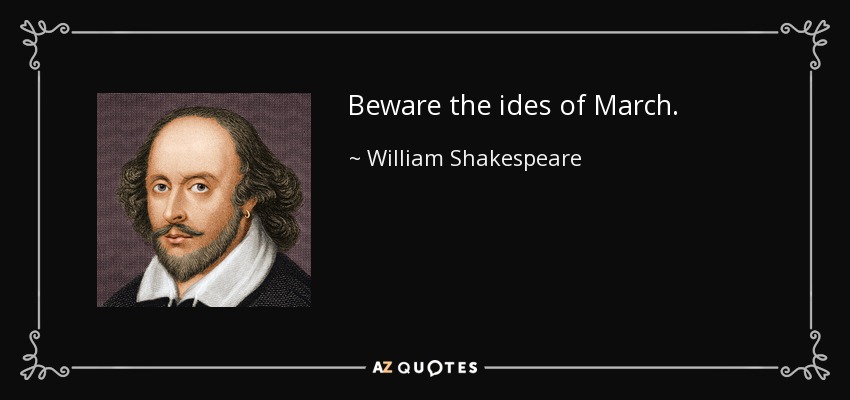
I'm participating in the Wednesday Quotes link-up hosted by Marsha at Always Write. And although the Ides of March is almost over by now, that's what I'll be writing about.
Beware the Ides of March. ~William Shakespeare
What is the Ides of March, and why should anyone be wary of it? We all quote the line, and I think a lot of us know it's from Shakespeare's Julius Caesar, but I suspect that might be all we know about it. I sure don't know much more than that, so I thought I'd find out.
Although some of the months in our calendar come from Roman names, the Romans didn't use quite the same calendar, and they didn't number the days like we do. They had three set points in each month, and it was based more on the moon. The Ides was the first full moon of each month. The Nones is the 5th or 7th or 8th days before the Ides, and the Kalends is the first day of the following month. The Ides falls on the 13th of most months, but on the 15th in four months, including . . . you guessed it! . . . in March. The Ides of March would be first full moon of a new year, and was the beginning of spring, which naturally meant feasting and celebrating.
On the Ides is held the jovial feast of Anna Perenna . . . The common folk come, and scattered here and there over the green grass they drink, every lad reclining beside his lass, Some camp under the open sky; a few pitch tents; some make a leafy hut of boughs, Others set up reeds in place of rigid pillars, and stretching out their robes place them upon the reeds,But they grow warm with sun and wine, and they pray for as many years as they take cups, and they count the cups they drink. ~Ovid
by night only crazy things
like the full moon and the whippoorwill
and us, are busy. ~Charles Olson
Does the full moon affect people's behavior, you ask? Yup. It makes people think the full moon affects people's behavior. ~Neil deGrasse Tyson
He made the moon to mark the seasons,
and the sun knows when to go down.
~Psalm 104:19~
The Ides of March was also the day that consuls (state officials) took office. At least until 153BC when, for some reason, the consuls started their terms on the first day of January. And then, along came Julius Caesar and in 46BC he changed the Roman calendar to establish January 1st as the start of the New Year.
Julius Caesar didn't get to celebrate very many New Years before he was assassinated. He was stabbed to death in the Senate house by a group of conspirators led by Marcus Junius Brutus and Gaius Cassius Longinus on the Ides of March in the year 44BC, and of course that's how the date came to be such a well-known one. And it was obviously a huge event that changed the course of Roman history. Following his death there were a series of Roman civil wars that finally ended with the rise to power of Octavian, Caesar's adopted heir. In 27BC Octavian became the emperor Augustus, and that was the end of the Roman Republic.
But back to Caesar and the Ides of March . . . Ovid wrote about Caesar's murder as an act of sacrilege. On the fourth anniversary of his death, Octavian executed 300 senators and others as a way to avenge Caesar. Beware the Ides of March, indeed!
I hope your Ides of March has been a good one, with nothing to beware of, and no bad moon rising other than the enjoyment of this classic song!
We are a participant in the Amazon Services LLC Associates Program, an affiliate advertising program designed to provide a means for us to earn fees by linking to Amazon.com and affiliated sites.
Happy Valentine's Day! I don't usually take Valentine's Day celebrations very seriously, but I like chocolate (preferably dark chocolate) and flowers as much as the next girl. Plus it's so sweet to see the younger couples being all romantic.
Romance is thinking about your significant other, when you are supposed to be thinking about something else. ~Nicholas Sparks
I think of love, and you, and my heart grows full and warm, and my breath stands still... I can feel a sunshine stealing into my soul and making it all summer, and every thorn, a rose. ~Emily Dickinson
A few years ago I got curious enough about the history of Valentine's Day to do a quick research project for my homeschool blog, and I'm reusing some of that info here. How did we arrive at Valentine's as a day for giving flowers and chocolates and cute heart-shaped cards from it's beginnings as a day to remember a Christian martyr? Turns out the history may even go further back than the Christian saints named Valentine or Valentinus (there were at least three of them, and all were martyred for their faith). A pagan Roman holiday called Lupercalia was celebrated in the middle of February, and it was a fertility festival. As you can imagine, it was deemed "un-Christian" and was outlawed; and it's entirely possible that the Church made the choice to celebrate a Christian patron saint of marriage at this time of year in an effort to "Christianize" and replace Lupercalia.
Valentine's Day is all about LOVE nowadays, but it did start out as the feast day of a Christian martyr. Saint Valentine's history is intertwined with legend, but it's known that he took a stand for Christian marriage during a time when the Roman emperor forbade his soldiers to marry. One popular story says that while he was in prison, Valentine became close to his jailer's daughter (they might even have been in love!) and when he was taken away to be executed, he left her note. It was signed, "From your Valentine".
During the Middle Ages, young men and women would draw names to see who would be their Valentine, and the names would be pinned to their sleeve, giving rise to the expression, "wearing your heart on your sleeve".
Oh! if it be to choose and call thee mine,
Love, thou art every day my Valentine.
~Thomas Hood, "For the 14th of February"
Valentine greetings were popular during the Middle Ages, with the first written greetings appearing during the 1400s. The oldest known valentine is a poem that Charles, Duke of Orleans wrote to his wife while he was imprisoned in the Tower of London in 1415. The practice of sending cards and flowers to loved ones on Valentine's Day became popular in England during the 1700s. By the middle of the 18th century, friends and lovers of all social classes exchanged these tokens of affection. Hallmark produced the first commercially printed card in 1913, and ready-made cards made it easier for people to express emotions during a time in history when that was not often encouraged. Today, more than a billion Valentine's cards are sold each year. And many people like to create their own cards - especially kids.
That heart shape, like the box your chocolates came in, wasn't representative of love until sometime in the 13th or 14th century. At that time the heart was thought of as a book of memory, where God's commands could be written, and where thoughts of one's beloved could be written as well. During the 14th century, an Italian poem accompanied by an illustration featuring hearts and a cupid throwing arrows and roses was what started our association of those lacy hearts and cupid's arrows with romantic love. You have Richard Cadbury (yes, Cadbury's chocolate) to thank for the traditional heart-shaped box of candy. He gave chocolates in a heart-shaped box to his sweetheart in 1868, and the company began producing the boxes with hand-decorated lids.
All you need is love. But a little chocolate now and then doesn't hurt. ~Charles M. Schulz
The best place to learn about true love is the Bible, where we find out just how much God loves us and how he wants us to love others.
Dear friends, let us love one another, for love comes from God. Everyone who loves has been born of God and knows God. Whoever does not love does not know God, because God is love. This is how God showed his love among us: He sent his one and only Son into the world that we might live through him. This is love: not that we loved God, but that he loved us and sent his Son as an atoning sacrifice for our sins. Dear friends, since God so loved us, we also ought to love one another.
~I John 4:7-11~
Jesus replied: " 'Love the Lord your God with all your heart and with all your soul and with all your mind.' This is the first and greatest commandment. And the second is like it: 'Love your neighbor as yourself.'"
~Matthew 22:37-39~
Since you have purified yourselves by your obedience to the truth, so that you show sincere brotherly love for each other, from a pure heart love one another constantly.
~I Peter 1:22~
Above all, love each other deeply, because love covers over a multitude of sins.
~I Peter 4:8~
Happy Valentine's Day!
*************************
Valentine's Day is a time to celebrate the joy of being in love. Unless you're single & lonely then it's called Laundry Day. ~Dane Cook
*************************
This post appears first on A Fresh Cup of Coffee, with material inspired by these posts from Homeschool Coffee Break in years past.
We are a participant in the Amazon Services LLC Associates Program, an affiliate advertising program designed to provide a means for us to earn fees by linking to Amazon.com and affiliated sites.
This post contains affiliate links - using affiliate links from HS Coffee Break helps fuel this blog.
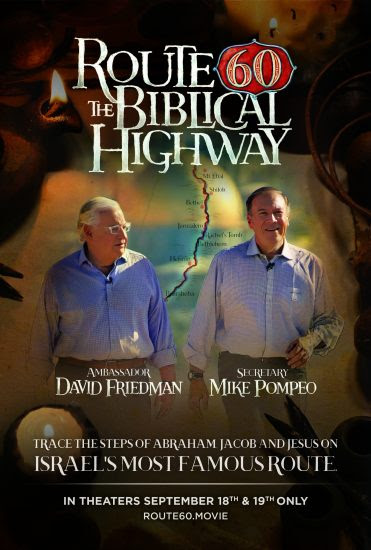
Movie Review: Route 60 - The Biblical Highway #Route60MIN In Theaters Sept 18 and 19
I had the privilege of seeing the advance release of this fascinating documentary and want to encourage you to see it in theaters if you can. It will be in theaters September 18th and 19th only, so grab your tickets today! If you're interested in Biblical or ancient history, I think you'll really enjoy it. It would be a great addition to history, geography, world religions, or Bible studies for homeschooling families; and for anyone looking for background to understanding the geography where the Bible stories took place and the foundations of the nation of Israel, and how it's all intertwined.
Route 60 is a documentary about Israel's famous highway, one that passes through sites of great historical significance, places where the patriarchs, kings and prophets, disciples, and Jesus himself walked.
Synopsis:
Carving through the heart of the Promised Land is the biblical spine of Israel, sometimes referred to as the Path of the Patriarchs and officially designated as Route 60. A highway of deep historical significance while often the scene of unrest and violence, this 146-mile road of asphalt and concrete begins in Nazareth, Israel's largest Arab city, and ends in Beersheba, one of Israel's high-tech centers. Running north to south, Route 60 connects ancient Israel with modern Israel, Jews and Christians with Muslims, and Israelis with Palestinians.
This trek is far more than a two-lane highway; it is a historic, sacred link to the roots of Judaism and Christianity and the stories of the Old and New Testaments. Follow world-changing diplomats David Friedman and Mike Pompeo as they venture down this sacred road, treading the very ground Abraham, Jacob, King David, and Jesus once walked. Discover the history, witness the healing, and realize the hope along Route 60, the Biblical Highway.
What others are saying:
"Visually stunning and compelling storytelling." ~Mike Huckabee
"ROUTE 60 combines the truth of the Bible with undeniable archaeological proof, and like our tour guides, Pompeo and Friedman, that's a powerful combination!" ~Erick Stakelbeck
My thoughts: The scenery and the views of historical sites was enough to draw me immediately, and the added graphics to help visualize the passages of Scripture referenced and the historical Biblical events were so appealing as well. But what I most enjoyed was the simple but compelling way Friedman and Pompeo related how the sites they visited were significant throughout the story of the Bible. Some of these sites, like Shechem and Bethel, are places where more than one greatly important event took place. I've watched many documentaries and video studies of sites in the Holy Land, yet some of the sites in ROUTE 60 were new to me, or I learned new context and significance to these places. Friedman is an Orthodox Jew and Pompeo is a Christian, and both have long and significant experience as American diplomats, so it was also fascinating to hear them talk about more recent history involving the nation of Israel such as the Abraham Accords and the relocation of the American Embassy to Jerusalem in light of Biblical history. Both men also told stories of the impact the truth of the Bible has had on how they view the world and the roles they've played, and about their personal faith as well.
Visit the movie's website Route 60 Movie to find out more.
We are a participant in the Amazon Services LLC Associates Program, an affiliate advertising program designed to provide a means for us to earn fees by linking to Amazon.com and affiliated sites.











 Posts
Posts