Showing posts with label english/language arts. Show all posts

Thursday, January 18, 2024

High School Writing Tip Sheets - Citing Your Sources (Update)

This post contains affiliate links - using affiliate links from HS Coffee Break helps fuel this blog. 


For the past few years I have been teaching high school writing in our homeschool tutorial co-op. Having seen several groups of students through the courses, I've noticed some issues and questions coming up regularly. I hope these Tip Sheets will be helpful to my students, their parents, and perhaps to other students and parent/teachers as well.

**********

In essays and research papers at the high school level, students should be able to provided a correctly formatted Works Cited page and should be able to use in-text citations, parenthetical citations, and signal phrases in their writing. Most students have learned at least some of these skills by the time they reach high school, but it can still be confusing. Here's a quick refresher and some good sources for more detailed information.

Source Information

As you're researching and taking notes, make sure to keep a record of all the sources you use, and which info came from which source. Note taking is probably an entire tip sheet of its own, but the basic gist is that you need to know specifically where each fact, quote, or reference comes from in the source. A good practice is to keep a Source Page or Working Bibliography as you research. Write down (or type) all the bibliographic information you'll need - author, title, publisher info, and date. For web sources, keep the specific URL and record the date you accessed the information. You may want to consider printing the information as well, if practical.

Works Cited Page

The most commonly used style is Modern Language Association (MLA), and if you use Google Documents or a Word program, you will find templates that format reports and Works Cited pages in MLA style automatically. Foolproof, right?! Well, yes, but you still have to know what information to plug in, what order it appears in, and how to correctly alphabetize the list. Alphabetize by the first item that appears for each source, which is usually the author's last name. Format is hanging indent, which means the first line of each entry starts at the left margin, and the second line is indented. Do not center. Works cited should appear at the end of your essay or paper, and on a separate page. Here's what it looks like using a couple of sources I recommend:


*Note that these examples are done following the 8th edition of MLA style.

In-Text Citations

When you use MLA documentation, you will use in-text citations, meaning you incorporate the source information in the text of your paper. When you use a fact, idea, or quote from one your sources, you use a signal phrase to let the reader know you're about to share something borrowed from the source. At the end of the quote or statement, you include a parenthetical citation that will refer the reader to the complete source information on the works cited page. Examples of signal phrases include:

According to author and teacher Sharon Watson,  . . .

" . . . ," writes Shona McCombes, a contributor at Scribbr.

At the end of the quotation or cited fact, you include a parenthetical citation. This is where you put the page number where the information is found in the source. If you did not include the author's name in the signal phrase, the author's last name should appear in the parentheses as well. Take a look at these examples:

In the textbook The Power in Your Hands, teacher Sharon Watson reminds students to include the credentials of anyone quoted so that readers will know the information is trustworthy (237). 

Correct punctuation can be a challenge, and questions often arise about the placement of quotation marks and end marks. A parenthetical citation is part of the sentence but not the quotation. "In other words, it appears after end quotation marks but before the period" (Watson 241). Another important detail to note is that there is no comma between the author's name and the page number.

**********

Those are the basics! Using in-text citations is not difficult, but it takes a bit of practice to remember some of the rules. Check out the following online sources with lots of detailed information about citing specific types of sources. 


On the Writing with Sharon Watson website, there are a number of free writing prompts and tutorials, including this one for In-text Citations for High School. You should also refer to the updated versions of a couple of lessons from the textbook I mentioned above, as the 8th edition of MLA style came out after publication of the textbook and there are a couple of changes to the format of citations. There is now a 9th edition of MLA style, and in my very quick check for changes to citations and Works Cited pages I didn't see anything different, but don't take my word for it! Go to the 2020 article: New Tutorials to Document Sources for an explanation of updates to MLA style and a link to download the 2020 lessons. These updated lessons from the textbook are available at no charge. 


The textbook The Power In Your Hands from Writing with Sharon Watson is the one I've taught from in the co-op for several years, and I highly recommend it. You can find out more in one of my full reviews. The most recent is: 


That review article was adapted and updated from our previous full review here: The Power in Your Hands (A Schoolhouse Crew Review) and an update in the Blogging Through the Alphabet series here: The Power in Your Hands (Blogging Through the Alphabet).

The Power in Your Hands (Writing Non-Fiction in High School) from Writing with Sharon Watson - A Homeschool Coffee Break review for the Schoolhouse Review Crew on kympossibleblog.blogspot.com  The Power in Your Hands (Blogging Through the Alphabet) on Homeschool Coffee Break @ kympossibleblog.blogspot.com

A previous version of this article was published on Homeschool Coffee Break in October 2021.

 Don't miss a coffee break! Subscribe to HS Coffee Break by email 

 ©2006-2024 HS Coffee Break. All rights reserved. All text, photographs, artwork, and other content may not be reproduced or transmitted in any form without the written consent of the author. http://kympossibleblog.blogspot.com/ 

 We are a participant in the Amazon Services LLC Associates Program, an affiliate advertising program designed to provide a means for us to earn fees by linking to Amazon.com and affiliated sites.


Monday, September 25, 2023

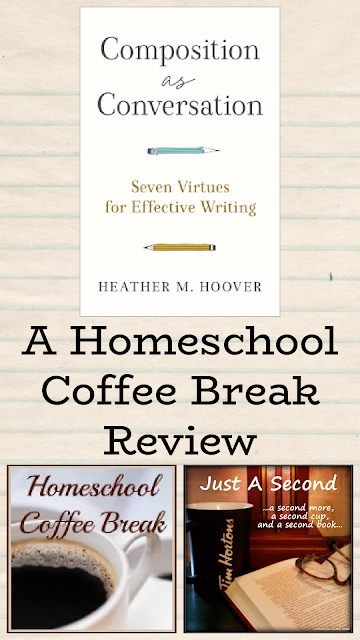
Composition as Conversation (A Homeschool Coffee Break Review)

This post contains affiliate links - using affiliate links from HS Coffee Break helps fuel this blog. 


My own children have graduated from our homeschool, but I still have the opportunity to tutor high school students in writing and literature, and therefore still appreciate finding useful resources for writing instruction. I was recently able to review Composition As Conversation by Heather M. Hoover, and enjoyed pondering the insights and ideas offered.


Heather M. Hoover (PhD, University of Tennessee) is a profressor of English and compositio at Milligan University, where she developed and has directed the writing program for fifteen years. She also directs the Master of Arts in Humanities and is the George and Janet Arnold Chair of the Humanities. She lives in Johnson City, Tennessee.

Although this concise guide to writing well is not a traditional textbook, it does offer valuable advice to students and instructors alike on how to improve the craft. Based on her experience as a college writing instructor, Hoover approaches composition as an ongoing conversation between the writer and readers. She begins with a question asked of her students about what makes a person an excellent conversationalist, and then applies seven of the top characteristics to the discipline of writing. This paradigm shift can invite and inspire writers to be more respectful and willing to continue learning about their subjects.

The suggestions and instructions are geared for college level students and classrooms, but I think the ideas could be adapted and incorporated into high school classrooms as well. In fact, high school students would benefit from learning how to be attentive and open-minded as they are developing their writing skills in preparation for college research. 

In my opinion, this book is best suited as a resource for writing instructors who wish to make their classroom more interesting and engaging, and inspire quality conversations and writing from their students. There is no lesson plan or syllabus, but many ideas for engaging students in ongoing discussions that will help them learn to listen and read attentively, and put their research and thoughts into more meaningful and relatable written conversations. There is an appendix of samples and templates for revision guides and peer reviews and the like that would be very helpful to many instructors. Certainly more advanced writers, especially at the college level, will find the book very helpful as well.

In keeping with her theme, Hoover's writing is conversational in tone and inspired me to ponder the ideas more deeply and consider how the suggestions could be useful in my high school level class for homeschool students. I was intrigued enough to purchase a paperback of the book when I was only about halfway through the digital ARC I received, so that I could easily highlight and annotate the instruction ideas I most wanted to incorporate into my classroom. 

From the publisher:

Teaching writing is not for the faint of heart, but it can be a tremendous gift to teachers and students. Students often approach writing courses with trepidation because they think of writing as a mystical and opaque process. Teachers often approach these same courses with dread because of the enormous workload and the often-unpolished skills of new writers. This approachable composition textbook for beginning writers contends that writing can be a better experience for everyone when taught as an empathetic and respectful conversation. In a time in which discourse is not always civil and language is not always tended carefully, a conversation-based wrirting approach emphasizes intention and care.

Written by a teacher with more than fifteen years of experience in the college writing classroom, Composition as Conversation explores what happens when the art of conversation meets the art of writing. Heather Hoover shows how seven virtues―including curiosity, attentiveness, relatability, open-mindedness, and generosity―inform the writing process and can help students become more effective writers. She invites writers of all skill levels to make meaningful contributions with their writing.

This short, accessible, and instructive book offers a reflective method for college-level writing and will also work well in classical school, high school, and homeschool context. It demystifies the writing process and helps students understand why their writing matters. It will energize teachers of writing as they encourage their students to become careful readers and observers, intentional listeners, and empathetic arguers. The book also provides helpful sample assignments.

This review also appears on my book blog, Just A Second: Recent Reads - Composition as Conversation

This title is available on Amazon for Kindle, or in paperback or hardcover.


Don't miss a coffee break! Subscribe to HS Coffee Break by email

©2006-2023 HS Coffee Break. All rights reserved. All text, photographs, artwork, and other content may not be reproduced or transmitted in any form without the written consent of the author. http://kympossibleblog.blogspot.com/ 

We are a participant in the Amazon Services LLC Associates Program, an affiliate advertising program designed to provide a means for us to earn fees by linking to Amazon.com and affiliated sites.

I have done my best to provide accurate pricing and links at the time this post originally appeared. Please be aware that these may change.


Thursday, May 18, 2023

Homeschool Coffee Break Reading List - May 2023

This post contains affiliate links - using affiliate links from Homeschool Coffee Break helps fuel this blog and our homeschool - thank you!


A long time ago I did an occasional round-up of articles, resources, and just fun things around the web and called it the Coffee Break Reading List, because this blog is the Homeschool Coffee Break, so of course! It included things unrelated to homeschooling too, as it was essentially a collection of the different things I was reading. As I finished the journey through homeschooling my own kids, I did continue tutoring and mentoring homeschool families, and was involved in the homeschool community, but I did this round-up less often, until eventually I left off doing it altogether. After a recent move, I started a new blog which is now the home of the Coffee Break Reading List, but because I still care deeply about homeschooling, I'm still going to try to do a homeschool related reading list here. Here are just a few things I've found during recent coffee breaks that you may find interesting as well.


The homeschool reading corner:

  • Enrollment in U.S. government schools dropped by over one million students from 2019 to 2021, and while some of that shift was certainly due to Covid lockdowns, the trend is continuing. Many parents are finding that public schools are unwilling or unable to provide help for students that are struggling, sometimes stating that scores aren't 'low enough' to warrant intervention. It begs the question, how far behind does a student need to be to prompt a public school to help? As public schools fail to address students' needs, more parents turn to alternatives (from The Lion) explains.
  • Since my son was a member of Civil Air Patrol, I found this article very interesting. A Virginia student who had been in Civil Air Patrol applied to an Air Force JROTC program but was told he was ineligible because he was homeschooled. Ryan Carbonel had plans to get into the US Air Force Academy, so this was a setback. Thanks to assistance from the HSLDA, the public school was informed that Carbonel did have the right to join the JROTC and he is back on track. Read more: Never Give Up: How a Teen, His Mom, and HSLDA Cleared the Runway to JROTC.
  • Congratulations to these homeschool students and to the Richmond Mall for this colorful art showcase, "Art Around the World", featuring artwork from homeschooled students at a local co-op. See: Homeschool Art Showcase Adds Color to Mall (from the Richmond Register)
  • I'm not sure about statistics, but it seems like families that homeschool are more likely to eat meals together. Anecdotally, a large majority of the homeschool families I know do eat at least one meal together on most days of the week. I saved this article quite some time ago, but I believe it's still relevant. Anita Ojeda asked Does The Family That Eats Together Have Better Mental Health? and also offered a few tips for making family mealtime work better. And that's news we can all use, even if we're not homeschooling!
  • Visit the HSLDA campaigns page to check on legislation affecting homeschooling in your state and the HSLDA recommendations on those bills.


The home is the first and most effective place to learn the lessons of life: truth, honor, virtue, self-control, the value of education, honest work, and the purpose and privilege of life. Nothing can take the place of home in rearing and teaching children, and no other success can compensate for failure in the home. ~David O. McKay

Dear friend, don't let the bustling culture determine the needs of your own children. You get to choose how they grow up. You can protect their time, energy, and imagination. You are the gatekeeper of the garden of their childhood. ~Ainsley Arment


Resource Spotlight:

This free webinar takes place this evening, so very time-sensitive! Learning to Write: Getting the Right Start! is a free 45-minute workshop Q&A provided by HSLDA. This workshop will help you introduce K-6 students to writing and cultivate their love of writing. 

Speaking of writing, one resource we liked a lot, especially for middle grades was Fix It! Grammar from Institute for Excellence in Writing (IEW). Their Structure and Style writing method is well-known for teaching composition. Fix It! Grammar is a series of six books that teach grammar skills and knowledge by having students find and correct errors in short daily passages that tell a story. It's an interesting and fun way to practice using grammar skills.

See our full review: Fixing Grammar with IEW

Fixing Grammar with IEW (A Homeschool Coffee Break Review for the Homeschool Review Crew) on kympossibleblog.blogspot.com


SchoolhouseTeachers.com has a Drivers Ed course! Did you know? I remember that when my kids were teens learning to drive, my state still required new drivers to learn from a driving school, so you will need to check what the laws are where you live. But either way, the Friendly Drivers Ed course will be a big help! It covers how to pass the exams to get the license, basic car science, safety, maintenance, and ownership concerns that every one of us needs to know. 


From the archives here at Homeschool Coffee Break: 

Curious about Civil Air Patrol, which I mentioned in one of the news stories? Here's an article I wrote about the organization in 2016 when my son graduated from high school: From the High School Lesson Book - Civil Air Patrol

From the High School Lesson Book - Civil Air Patrol on Homeschool Coffee Break @ kympossibleblog.blogspot.com


Our daughter just graduated from university, and this is the season for graduations! Got me thinking about many of the graduation traditions like the cap and gown, and I remembered mentioning a few of those traditions when I wrote about my son's high school graduation a few years ago. I suppose I should share about my daughter's latest achievement here - watch for that post coming soon! For now, you can check out: From the High School Lesson Book - Graduation

From the High School Lesson Book - Graduation on Homeschool Coffee Break @ kympossibleblog.blogspot.com - What our group's commencement exercises are like, and a little history about some grad traditions

My personal coffee break reading:

Fair As A Star by Mimi Matthews
The Keys to Gramercy Park by Candice Sue Patterson

Find out more at my book blog Just A Second.


Found anything interesting on the web lately? Read any good books? Leave a comment and let me know!

Don't miss a coffee break! Subscribe to HS Coffee Break by email 

 ©2006-2023 HS Coffee Break. All rights reserved. All text, photographs, artwork, and other content may not be reproduced or transmitted in any form without the written consent of the author. http://kympossibleblog.blogspot.com/ 

 We are a participant in the Amazon Services LLC Associates Program, an affiliate advertising program designed to provide a means for us to earn fees by linking to Amazon.com and affiliated sites.


Tuesday, April 25, 2023

High School Writing Tip Sheets - Scenes, Summaries, and Stories

This post contains affiliate links - using affiliate links from HS Coffee Break helps fuel this blog. 


For the past few years I have been teaching high school writing in our homeschool tutorial co-op. Having seen several groups of students through the courses, I've noticed some issues and questions coming up regularly. I hope these Tip Sheets will be helpful to my students, their parents, and perhaps to other students and parent/teachers as well.

**********

Since I was back at my old stomping grounds this week, I had the opportunity to guest teach (it wasn't really substituting, since it was originally my class?!) at the co-op, and we talked about the difference between a scene and a narrative summary, and some related ideas when it comes to writing fiction. I thought that might be a good topic to discuss in a tip sheet too. 

Since my classes use the textbook Writing Fiction [In High School] from Writing with Sharon Watson, and follow most of the assignments in the given order, students are most often asked to write scenes. On occasion, they're assigned a short story but that's the exception. We learn about plot structures and aspects like the Major Dramatic Question that are related to an entire story, whether a short story of a couple of pages or a full-length novel, but the students are asked to write scenes. A fair question might be, "Why just scenes?" or even, "Why wait until this late in the text to explain the difference between scenes and stories?"

Writing just a scene instead of needing to write an entire story means that students can work with a smaller cast of characters, can jump into a story without developing all the background and how it all started, and can end their writing assignment on a cliffhanger, or without needing to resolve the conflicts they've created. So that answers the first why question.

The second why question is a little tougher, and after the first year I taught this course, I figured out that it was helpful right near the start of the year to explain what I expected when I assigned a scene, and what made a scene different from a whole story or narrative summary. A lot of my assignment reminders endeitd with a line something like, "Remember: you don't have to resolve all the conflicts. This is only a scene, so it's just part of a larger story that you don't have to tell in this assignment." 

The chapter that I taught from this past week, and will finish in the next class goes into the nitty gritty about the differences, discussing what constitutes a scene and what constitutes a narrative summary, and when and where a writer would need to use narrative summary.

What Is A Scene?

A scene could be defined as the action of the story being described in real time, and complete with the appropriate descriptions of action, dialog, and narrative actions. Generally, there will be enough information in a scene that it could be reconstructed and acted out without too much guesswork. If there's dialog between characters, much of it will be written out with speaker tags and narrative actions. The action of the scene will be sort of a blow-by-blow account of what the character or characters do. 

A scene is a story within a story, in a sense, because there should be a scene goal which is a lot like the Major Dramatic Question of the whole story. The protagonist, or the main character in the scene, has a goal, and some kind of obstacle arises to keep him or her from reaching that goal. By the end of the scene it's clear whether or not the character has achieved the scene goal, and there has been some conflict or tension introduced. There may be some new information introduced as well. 

A scene also takes place in one setting. A particular timeframe in the story, and in one general location in the story. It can be helpful to think of it as a scene in a stage play. The action of Scene I takes place inside the palace, for example, so that is the backdrop or set. At the end of Scene I there may be a curtain or the lights will go down so that the backdrop can be changed for Scene II, which takes place the next day in the garden. If time has passed but the location is the same, there may be a curtain in order to indicate to the audience that Scene III, which still in the garden, takes place a week later.

Beginning and Ending a Scene

The beginning of the scene needs to have setting established, so an indicator of place, time of day, weather, season, or whatever  is needed to let the reader know when and where this part of the story happens. The scene question should be stated or implied fairly early in the scene, and this can be done through dialog or description of the character's thoughts or feelings. Some conflict or obstacle will get in the way of the main character's attempt to get what he was hoping for in the scene. This may or may not be successful, but it should bring some tension into the story. 

By the end of the scene, this new conflict has been dealt with in some way, at least partially, and the character has either achieved the goal or hasn't. He may have also learned new information, or the reader may be given new information that impacts the story. The character's situation should have changed during the scene. He has learned something, lost something, gained something, been wounded, found a new ally or enemy, or won or lost a battle. The end of the scene should naturally lead to the next scene or hint at more conflict or complications to come. After all, unless this is the end of the novel, you want the reader to turn the page and keep reading!

What Is Narrative Summary?

It's called narrative summary because that's what it does. It summarizes and condenses the narrative, and it's a very useful tool when used correctly. Instead of that play-by-play dialog and action, the narrative summary will tell you in a sentence or two that the characters talked or did something, but without details. Think about a murder mystery novel. There might be a week that goes by between scenes during which the detective is working on the case but there are no significant developments. The narrative summary might be a paragraph stating just that. Or the narrative summary might be a paragraph or two that narrate the detective's thought process as he reviews all the information he has so far and figures out which lead to pursue next and how. Passages in a story that focus on what a character is thinking or their emotional state.

Narrative summary can also be used to describe setting, a character, or some detail; or to explain information that the reader will need to understand something in the story.

Narrative summary is often useful at the end of a scene, if the character needs to reflect on or process what has just happened in the scene's action. This is called a sequel. 

Quick Tips:

If your assignment is to write a scene, establish the time frame and place for your scene. You've already learned that your characters need motivation in the form of a Major Dramatic Question, so apply this same idea by giving your main character a scene goal. The overall goal for Rapunzel in the movie Tangled was to see the floating lights, but one scene goal would be to convince Flynn to be her guide. In another scene, her goal would be to heal the cut on Flynn's hand. Decide on the scene goal for your character and what conflict will get in the way of them achieving the goal. Write your scene, making sure you stay in that location and time frame. 

If you look back at what you've written and realize that it covers weeks or months or years, you've probably written narrative summary instead of a scene. If you intended to write a scene about an argument between a grown brother and sister, but most of what you've written is backstory about their childhood and why they haven't spoken to each other since they were teenagers, you've probably written narrative summary. 

If you're writing a short story, look for the same balance. The story will have more than one scene, and will need some narrative summary to connect those scenes. Generally, you want more scene than summary. That's where your proofreading and editing step can be very helpful. Have a critical eye to what is necessary to your story. Make the dialog worthwhile; use your description tools for those elements that are important for characterization and setting; make sure your narrative summary transitions are brief; and if necessary, use narrative summaries for a main character to reflect and plan between scenes.

When you write a story, you are telling yourself the story. When you rewrite, your main job is taking out all the things that are NOT the story . . . Your stuff starts out being just for you . . . but then it goes out. Once you know what the story is and get it right, as right as you can . . . it belongs to anyone who wants to read it, or criticise it. ~Stephen King

**********


Sources for this article include: Writing Fiction [In High School] from Writing with Sharon Watson

 Don't miss a coffee break! Subscribe to HS Coffee Break by email 

 ©2006-2022 HS Coffee Break. All rights reserved. All text, photographs, artwork, and other content may not be reproduced or transmitted in any form without the written consent of the author. http://kympossibleblog.blogspot.com/ 

 We are a participant in the Amazon Services LLC Associates Program, an affiliate advertising program designed to provide a means for us to earn fees by linking to Amazon.com and affiliated sites.


Monday, April 3, 2023

High School Writing Tip Sheet - The Plot Thickens (Part Two)

This post contains affiliate links - using affiliate links from HS Coffee Break helps fuel this blog. 


For the past few years I have been teaching high school writing in our homeschool tutorial co-op. Having seen several groups of students through the courses, I've noticed some issues and questions coming up regularly. I hope these Tip Sheets will be helpful to my students, their parents, and perhaps to other students and parent/teachers as well.

**********
Last week we explored The Hero's Journey as a plot framework, and although it was meant to be a brief overview, it was quite long! Today I'm outlining another plot framework that is taught in my Creative Writing classes based on Writing Fiction [In High School] from Writing with Sharon Watson, and I promise this article will be shorter!


This plot framework is based on a 1900 play by Austrian Arthur Schnitzler. Schnitzler's play, which was titled La Ronde, was a series of two-character scenes in which something was given from character to character. The first scene is between a prostitute and a soldier, the second between the soldier and a maid, the third between the maid and another character, and so on until the final scene between a count and the prostitute from the first scene. The 'something' that is passed from character to character until the story comes full circle is a venereal disease. The play was making a social commentary on morality and class boundaries, but the point was made through the disease being passed on regardless of class or outward show of morals.

So here's the basic idea of the structure: A thing of some kind is passed from one person to another in the story, until it comes full circle, and that thing represents or symbolizes something else―an idea or concept which is the theme of the story. 


Let's look at some examples mentioned by Watson in the textbook. There are two episodes of the classic TV series M*A*S*H* that were written by Alan Alda using the idea of passing something around. In "The Long John Flap" a pair of long johns arrives at the army hospital during a very cold winter, and everyone there wants those long johns. The characters barter, threaten, and wager to get those long johns. Of course it's funny, but the story is not about who gets the long johns, but about the characters themselves and the relationships between them. What are they willing to do in order to get what they want? The other episode is "The Rooster Crowed at Midnight". In this one, one of the soldiers receives a book in the mail. It's a murder mystery and everyone wants to read it. The book is passed around―sometimes being stolen or traded for―but no one finished reading until the end of the episode. At that point it's discovered that the final pages have been ripped out of the book and so no one knows how it ends! What is this one about? Perhaps it's a commentary that no matter what we do, no one really knows how things will turn out in the end or even what might happen next in life.

A book from a few years ago, The Sisterhood of the Traveling Pants by Ann Brashares, also uses a la ronde style plot. Four teen friends have to spend the summer apart and don't know if they'll see each other again. They find a pair of pants that fits them all, and decide to send the pants around to each other over the summer as a way to stay in touch. They establish rules for what to do with the pants and what can be done while wearing them. The story is really about the girls' relationship and how each one deals with her own struggles.

If you are writing a story of your own with this plot framework, here's what to consider. Decide what will be passed around among the characters. Will it be passed unwittingly or on purpose? If it's passed on purpose, will there be rules established or will each character make their own decision about who gets it next and how it will be given? Remember that the object should come back to the first character somehow. What is the story really about? What does the object being passed around symbolize or represent?

 A family decides to pass a cherished heirloom or diary from one character to another as a way to remember the loved one that has passed on. This is a very intentional symbolism that each member of the family is aware of from the start.

A character gives a small gift to another character to cheer them up, not knowing that the recipient will pass that gift on to another character and so on until the gift is given back to the first character. This is another intentional symbolism where the object may represent hope or encouragement. There may or may not be any instruction given by the characters to pass it along to someone else. The object passed may have very little monetary value, which emphasizes that it is a symbol.

An object can be found and passed from one character to another until it finds its way back to the original owner. This idea can be done with a prologue in which someone loses the object or is unable to take it with them. Again, this one can be very intentional or serendipitous in how the object is passed around and this lends itself to either serious or lighthearted in the symbolism, as long as the idea the object represents is consistent from one character to another.

You can write something like Alda's screenplays for the M*A*S*H* episodes, with a sought-after object being traded and stolen and argued over, with a lot of humor involved, but the object and interactions needs to represent something more than just the object everyone wants. So while a story about teenage boys having a game of stealing a baseball cap from each other in silly ways might be entertaining, it still should be clear that the cap represents something such as their support of each other despite their disagreements. 

One example from my family that I've shared with classes as a story idea is the squishy minion at my house. A couple years ago, I got a minion toy that is kind of like one of those spongy stress relief balls in a gift basket. He sat out on my counter for awhile because I wasn't sure what to do with him. Then one of the kids decided to hide him to see how long it would take me to notice. He was very cleverly hidden! And once I found him I hid him and then the game was on to see who would find him next. This game has been going on for awhile, and the rules are that whoever finds the minion gets to hide him next, and he must be hidden in a part of the house that everyone has access to (so not in your own bedroom), and where he's very unlikely to be accidentally discarded or destroyed (so not in the bottom of a trash can or in the dryer vent). What does the minion represent? That's not quite as clear, but maybe family ties or perseverance. When I visit the kids in a couple weeks, one of my goals will be to find the minion and then hide him for the kids to find after I've left.


There are only so many plots in the world. It's how they unfold that makes them interesting. ~Lauren Beukes
**********


 Don't miss a coffee break! Subscribe to HS Coffee Break by email 

 ©2006-2023 HS Coffee Break. All rights reserved. All text, photographs, artwork, and other content may not be reproduced or transmitted in any form without the written consent of the author. http://kympossibleblog.blogspot.com/ 

 We are a participant in the Amazon Services LLC Associates Program, an affiliate advertising program designed to provide a means for us to earn fees by linking to Amazon.com and affiliated sites.


Friday, March 31, 2023

High School Writing Tip Sheets - The Plot Thickens! (Part One)

This post contains affiliate links - using affiliate links from HS Coffee Break helps fuel this blog. 


For the past few years I have been teaching high school writing in our homeschool tutorial co-op. Having seen several groups of students through the courses, I've noticed some issues and questions coming up regularly. I hope these Tip Sheets will be helpful to my students, their parents, and perhaps to other students and parent/teachers as well.

**********

Today we're going to discuss the concept of a plot framework that is very widely used in literature―the Hero's Journey. The Hero's Journey structure is discussed in Literature classes because so many novels and plays and other works are based on this framework, and students writing fiction can make use of this template for their stories as well. 

Even if you've never taken a Literature class, or studied plot structure in a writing class, I bet you're familiar with the Hero's Journey, even if you don't recognize it by its name. Even if you're not a reader of classic literature! If you're familiar with Harry Potter and the Sorcerer's Stone, The Hunger Games, Star Wars, The Lion King, or The Hobbit, just to name a few, you have read or seen a Hero's Journey story. It's the same basic narrative pattern going all the way back to ancient literary forms we call "epics" which were often written in poetic form. Think Homer's Odyssey.

In 1949, an academic named Joseph Campbell published a mythology book titled The Hero With a Thousand Faces, in which he described his theory that all mythological narratives follow the same basic structure. He called it a 'monomyth' or Hero's Journey. In 2007, screenwriter Christopher Vogler expanded on this concept in his book, The Writer's Journey.

A hero ventures forth from the world of common day into a region of supernatural wonder: fabulous forces are there encountered and a decisive victory is won: the hero comes back from this mysterious adventure with the power to bestow boons on his fellow man. ~Joseph Campbell, The Hero With a Thousand Faces

Or how about this description: some crisis forces the lead character to get out of his comfort zone and confront his worst fears or tackle his biggest obstacles in order to rescue someone or achieve something he values. The conflict almost destroys the hero in some way, but against the odds he wins, and his life returns to a new normal. New because he has learned and grown from the experience, and now has something of great value to contribute to his community.

You've seen that movie or read that book, haven't you? We all have, in one form or another. Let's break it down a little bit.

Heroesjourney

The Basics of the Journey


The Hero's Journey has three broad stages to it, each of which can be broken down further. Let's start with the basic three:

The Departure - The hero receives some type of call to adventure and leaves the familiar world behind.
The Initiation - The hero learns to navigate the unfamiliar world, facing various tasks or obstacles, often with the help of a mentor. There is a prize of some kind that the hero wins.
The Return - The hero returns to the familiar world, realizing how the adventure has changed him.

You can see that the story is not just about the things that happen to the character, but also about how the character is changed, almost always for the better. This is called a character arc. The hero may return physically to the same place he started from, but he has grown or changed personally.

Each of the stages can be broken down into smaller sections. Some sources say it's twelve stages altogether, others say it's seventeen. Not every one of these smaller steps will necessarily be present in every novel or movie you analyze, and not every sub-step is necessary if you are writing a story with this structure. The sub-steps may be combined or be slightly different in order, and a stage that involves crossing a threshold from one world to another could straddle the two stages.

The Departure


This stage includes the Introduction or Ordinary World, the Call to Adventure, the Refusal, Meeting a Mentor, and Crossing the Threshold.


At the beginning of the story, we're introduced to the hero and find out what his Ordinary World is like. The hero should be introduced as a sympathetic character with some needs and wants that will drive his decisions. There should be a hint that something isn't quite right or is missing in that existence. Examples: Harry Potter lives with his aunt and uncle and sleeps in a cupboard, or Bilbo Baggins in his comfortable, predictable Hobbit hole in the Shire.

Something happens to disturb this Ordinary World and spur the hero to take some unexpected and often unwelcome action. This is the Call to Adventure. Usually this involves some kind of Refusal, with the hero initially being afraid or feeling unworthy, but the crisis is something that cannot be ignored. This is an introduction of conflict and the hero will be compelled to step out of his ordinary world. The refusal is often a clue to what the hero's biggest fear or weakness is, because they will need to overcome it. Examples: R2-D2 plays a message from Princess Leia pleading for help, but Luke initially refuses to leave his home planet, and Neo (in The Matrix) receives a message telling him to follow the white rabbit but he doesn't trust Trinity and allows himself to be captured.

Around this time, the hero Meets a Mentor. In mythology, fantasy or fairy tale type stories, the mentor might be a character with some supernatural powers. Even if the mentor doesn't have magic powers, the mentor helps the hero by giving advice or imparting a skill or gift that will help the hero succeed. Sometimes the mentor is the one that gives the hero the kick in the butt they need to answer the call, and sometimes the hero doesn't meet the mentor until they're on the way. Examples: Mr Miyagi agrees to train Daniel in karate (The Karate Kid), and Aladdin meets the Genie and is granted three wishes.


Crossing the Threshold is the transition from the ordinary world into the unfamiliar world. The hero has a mentor and a newfound skill, weapon, or gift that makes him as ready as he'll ever be to enter the unfamiliar world and start the next stage of the journey and conflict. It's about a quarter of the way into the novel or movie, and this is a decision point for the hero; there's no turning back! He will be doing something new and he'll probably be scared. There may be a task or confrontation at this point, where the hero has to do something to gain entrance to the new world. If there's an opposition character here that the hero has to get past, we call them the Threshold Guardian. Sometimes the Guardian can be turned into an ally of the hero. Examples: Neo chooses the red pill and is shown the Matrix, and Frodo and Sam leave the Shire with the ring.

The Initiation


This stage includes Learning the Rules; Tests, Allies, and Enemies; Approaching the Cave; the OrdealRebirth/Resurrection and Taking the Prize.

Once in the new world, the hero has to Learn the Rules. He may have gone from a realistic world to a magical world, and has to learn how the magic works. Or he may have entered an arena of some type and needs to learn the rules of engagement in the game. Like Katniss training in the Capitol before entering the arena. During this stage there will be Tests; and the hero will meet or make Allies and Enemies. There is a series of conflicts that will lead to the climactic showdown, and the hero will usually fail in one of these early battles against the antagonist. These smaller tests or battles will also serve to hone the hero's skills and he will learn valuable lessons from them. The hero meets other characters that will either accompany and help him, or oppose him. Examples: Marlin and Dory encounter sharks, jellyfish, sea turtles, and a blue whale on their journey - Some of these characters are helpful and some are not; some are both! And Dorothy already has her dog Toto, but she meets Glinda, the Scarecrow, the Tin Man, and the Cowardly Lion on her way to Oz. 

There's usually a calm before the storm portion of the story somewhere in this world. It serves as a place for the hero to reflect on the journey so far and is a relax in the building tension before the conflict ratchets up for one final battle. This calm is sometimes called Approaching the Cave. Wherever it happens in the story, it is a preparation for the Ordeal. This is the climactic conflict, the fight to the death, the battle where everything is on the line for the hero and despite all the preparation the odds are against him. But of course, the hero wins the day. Examples: Princess Leia is rescued and Luke Skywalker uses the Force to destroy the Death Star, Carl Frederickson chooses his house over Russell, but then when he realizes the danger Russell is in and how evil Muntz really is, he and Dug go to rescue Russell and have to engage Muntz in a huge battle.


The Rebirth/Resurrection or Death-to-Life Experience can happen as part of the epic battle Ordeal, or may happen later in order for the hero to return home. Some heroes die or are near death physically in their great battle, but are revived supernaturally. Sometimes the death is not physical but the death of a dream or ideal, or giving up of something the hero thought was important only to find a new purpose or object of affection that is better. What's important is that in order to fully triumph over the antagonist and get the prize or boon, the hero must essentially give up something of himself for a greater good, or without knowing that he will survive. Examples: When Mother Goethel stabs Flynn, Rapunzel sacrifices her freedom in order to use her hair to save Flynn. That is her ordeal and her "death". But Flynn also has a death-to-life ordeal here, as he cuts off Rapunzel's hair, knowing he will die but giving her the chance to be free of Goethel. By the way, his line at this point is an example that the death-to-life is not always physical. His last words are, "You are my new dream." Although Flynn opens the movie by saying that it's Rapunzel's story, they each complete their own hero's journey in the movie Tangled

Having won the battle, the hero can now claim the prize or boon! Taking the Prize might mean a tangible reward or the reward might be the satisfaction of achievement or the knowledge that something or someone the hero cares about is safe. Often the prize, once received, is revealed to be of greater value to the hero than he had even realized. Examples: Dorothy escapes from the Wicked Witch's castle with the broomstick and with the ruby slippers, both of which help her to return home to Kansas. Carl's rewards in Up! are the dogs he brings back with him and his friendship with Russell which gives his life purpose. Aladdin's prizes are the friendship of Genie, the respect of the sultan, and the love of Princess Jasmine―which you might remember the Genie said he couldn't get with his three wishes.


The Return


The hero has triumphed and now is ready to return home, so in this stage you'll see him Crossing the Threshold Back and Mastering Two Worlds.

At some point after the decisive battle the hero will need to return to his Ordinary World. He might be reluctant to return, just as he was initially reluctant to begin the adventure. He might want to stay in the Adventure World, or he might be afraid of what awaits him back home, or what the boon might mean. The return is not an easy journey, because he'll have to Cross the Threshold to Get Back. The trials of returning tend to reinforce why the hero had to go on the journey in the first place. 

As a result of his epic journey, the battles won, the death and rebirth experience, and the prize gained, the hero is forever changed somehow. This is where the character arc resolves, with the hero becoming better in some way. In a sense, the hero is now learning how to Master Two Worlds. This may involve figuring out how to bestow the boon on his ordinary world, making some sort of atonement for the mistakes he made before the journey, or simply being reconciled to this new status. Examples: After returning Princess Leia to the Rebel Base, Luke joins the rebellion after all, and Sam and Frodo have different experiences when they return home after destroying the One Ring. Sam returns braver, marries Rosie, and builds a new life in his original world, while Frodo is traumatized by all he's been through and leaves the Shire to build a new life elsewhere. After defeating Voldemort (in the first book), Harry Potter returns to his aunt and uncle's and enjoys the summer because he knows he has a place at Hogwarts.


There are only so many plots in the world. It's how they unfold that makes them interesting. ~Lauren Beukes
**********

Once you're familiar with the Hero's Journey, it's amazing how many novels and movies follow this basic plot! Think of your favorite superhero movies and chances are they are a variation of the Hero's Journey.


Sources for this article include: Writing Fiction [In High School] from Writing with Sharon Watson; Breaking Down the Hero's Journey Plot Structure at Well-Storied; Hero's Journey at ReedsyBlog; The Hero's Journey at Think-Written; Plot Structure: The Hero's Journey at Novlr; and Writing101: What Is The Hero's Journey? at MasterClass


 Don't miss a coffee break! Subscribe to HS Coffee Break by email 

 ©2006-2023 HS Coffee Break. All rights reserved. All text, photographs, artwork, and other content may not be reproduced or transmitted in any form without the written consent of the author. http://kympossibleblog.blogspot.com/ 

 We are a participant in the Amazon Services LLC Associates Program, an affiliate advertising program designed to provide a means for us to earn fees by linking to Amazon.com and affiliated sites.